MLB

Winter Meetings Day One

The MLB Winter Meetings are just getting underway at the Gaylord Opryland Hotel in Nashville, just 20 minutes from Vanderbilt campus. I got a press pass with the Vanderbilt Hustler and here are some of my updates from throughout the afternoon, which you can also follow on Twitter.

3:27 PM CT – Joe Torre on WBC:

Joe will be managing the US team at the World Baseball classic. He mentioned that he doesn’t want to overwork his pitchers, specifically that he will talk with each player’s manager and general manager to make sure that he doesn’t deviate from how his team would normally handle his workload.

When asked if he ever gets the itch to manage again, Torre sad that he did not anymore. He said that every game was a do-or-die of sorts and that the lows are too low after losses.

Torre was asked how important it is for the US to win the WBC as a sort of comparison to the Dream Team, but the first thing he mentioned was the importance of growing baseball internationally. He did stress that the team is set on winning, but that the competition would definitely be steep, especially from Latin America.

Torre discussed the rosters, which are not final, and said that about half the players would be pitchers. Additionally, there will probably be at least three catchers, since few catchers will likely be ready to play nine innings per game in March. He also mentioned the importance of role players in addition to stars.

Finally, Torre said he thought the key to winning would be pitching and defense. Plus the experience of managing near-All-Star Teams before would help, although it hurts that he doesn’t have a previous relationship with all of his players

3:55 – Mets and R.A. Dickey

The Mets are definitely open to moving Dickey, although the price will be steep. The asked the Red Sox in a meeting for both Xander Bogaerts and Jackie Bradley Jr. Dickey is two years from free agency, but the Mets also ran a similar hard bargain two years ago when the tried to move free agent-to-be Carlos Beltran, ultimately netting Zach Wheeler.

The Red Sox reportedly do not want to include either prospect in the deal. It’s unclear if either prospect would be available at all.

4:17 – Dusty Baker, Reds Manager

Dusty was asked about Aroldis Chapman and if he thinks a pitcher needs three quality pitches to be a starting pitcher. Dusty said that he doesn’t think it is mandatory for a starter to have to throw three pitches well, but if they don’t they need pinpoint accuracy. He said that he thought Chapman’s slider was excellent, but the changeup still needed work, especially over longer outings.

Baker also brought up the potential need for a way to limit Chapman’s pitches, although he said they didn’t have one single plan in mind, should the Reds move him to the rotation. He suggested a few ideas, including possibly shutting him down early in the year, limiting his pitch counts, spacing out his starts longer, and other “creative solutions.”

Baker also had high praise for young shortstop Zach Cozart, saying that he loved the kid’s attitude. His arm and running, though needed improving, along with, obviously, his bat. The manager had high praise for his glove, which he said was “very steady for a young player,” and also added that he didn’t want to sacrifice defense at shortstop.

On the subject of instant replay, Dusty said that he would like to see replay expended, although he also wishes umpires would reach their conclusions faster. To sum up his thoughts, replay is fine “as long as they can do it in a timely fashion.”

4:27 – Ned Yost, Royals Manager

Yost mentioned that the Royals are still looking to add starting pitching, fitting in with the reports that the team was pursuing James Shield and Jon Lester, possibly in return for super-prospect Wil Myers. He said that Luis Mendoza would definitely get a shot to keep his rotation spot, but if he didn’t win it, he’d definitely still remain on the roster as a long reliever.

If Myers did get traded, though, Yost said the team would have to depend upon Jeff Francoeur to have a bounce-back season. For the time being, they would still like to add an outfield bat, perhaps on the non-tender list–whether or not they end up dealing Myers. For the future, though, Yost said he is very excited about Jorge Bonifacio, among other outfield prospects.

4:36 – John Gibbons, Blue Jays Manage

Gibbons was very excited to be back managing in the big leagues, saying there is more pressure than before, although there is always pressure coaching in the majors. There was a definite excitement in his voice about the strength of his new team. Among the new players, Gibbons said he expects Mark Buehrle to be a team leader, whether vocally or by example.

Gibbons did divulge a bit about his lineup, saying he will start out the lineup with Jose Reyes, Melky Cabrera, Jose Bautista, and Edwin Encarnacion for sure. Otherwise, he said nothing was set. Additionally, Maicer Izturis was signed as the starting second baseman, but he could be moved around the diamond. At the same time, Emilio Bonifacio could play second or in the outfield.

On the subject of the bullpen, Gibbons pointed out that a strong pitching staff makes a strong bullpen. He said that a lot of the roles have yet to be determined and may not be finalized for most of the year, but the more firepower he has the better. As for the closer’s role, Gibbons said that, again, nothing was finalized between Casey Janssen and Sergio Santos, especially since both are coming off injuries.

Finally, Gibbons also talked about some of the faster players on the team, saying that he didn’t want to rein in any of his faster players stealing, although “there are players in the middle of the order paid to knock them in.”

4:55 – Terry Collins, Mets Manager

Collins was asked a lot about potential moves and players he might be interested, but he noted that he didn’t have much say in transaction. Although it’s not up to him, he did say the team is looking for another right-handed bat in the outfield. In terms of whether the team is trying to contend or rebuild, he did said “everybody wants to win now,” although it’s a bit unclear if “everyone” is the Mets or just teams in general.

As for minor league pitchers, Collins said that Jenrry Mejia will come into the season with a chance to start for the major league team out of spring training. If Jeurys Familia starts the year with the Mets, though, he would be pitching out of the bullpen. Collins stressed the importance of minor leauge pitchers starting, rather than relieving, even if their future is in the bullpen, hinting that Familia would start in AAA, should he not begin the year in the majors. On the subject of Zach Wheeler, Collins expects him to follow the path of Matt Harvey last year, although Wheeler will get a chance to break camp with the major league club. Finally, Darin Gorski, will also have an outside shot at starting the year in the majors.

Collins got a very large proportion of his questions about R.A. Dickey, but kept reiterating that he loves R.A., has no control over whether or not he is traded, and that “it’s a matter of movie forward with who we have.”

Lastly, Collins added that Justin Turner would not be an every day player, but rather he would be a super-utility player. He said that Turner would be taking reps in the outfield every day.

5:05 – Bob Melvin, Athletics Manager

Melvin said that the team has a lot of free agent decisions, but that the team is not in a particular rush. Jonny Gomes already signed with Boston, but Brandon McCarthy and Stephen Drew, among other players, remain un-signed. The A’s are reportedly courting both Drew and Hirojuki Nakajima, although Melvin said the team would be fine with the players they currently have at shortstop. He said their currently players aren’t very experienced and aren’t putting up much offensive numbers. He also noted that being in a relatively unattractive small market doesn’t help out.

With the addition of Chris Young, Melvin said the team will be rotating outfielders (Young, Yoenis Cespedes, Coco Crisp, Josh Reddick, and Seth Smith) through the DH position to give the players some extra rest. He also said that the A’s were not looking to trade any outfielders, especially Cespedes, whom he said has the sky as his limit.

As for other positional battles, Melvin said he was comfortable and optimistic about having a lefty/righty platoon with Chris Carter and Brandon Moss. Alternatively, he said Derek Norris is without a doubt the starting catcher, although George Kottaras will have a solid amount of playing time.

Melvin also stressed that the team doesn’t really need to add much more pitching with six solid young pitchers. He did say that there wouldn’t be the same group of five starting pitchers in the rotation all season.

Melvin also spoke at length about the team’s new addition, Chris Young, who Melvin coached during his time in Arizona. The coach said that the front office asked him about Young prior to his acquisition and that he really liked Young’s athleticism and versatility. He also suggested that Young would likely lead off against left-handed pitchers, although he could also hit cleanup.

5:42 – Keith Law!

I got the great opportunity to talk with the great Keith Law for a bit, definitely one of my personal highlights of the winter meetings. Some of the conversation wasn’t on the record, but he gave some great advice and was very nice to meet up with a random college sportswriter.

5:46 – Joe Maddon, Rays Manager

Maddon stressed that if the Rays are to win 90 games on a regular basis, they need to pitch well and defend well. He said that you cannot out-hit or out-spend other teams; “to be as pitching rich as possible is very attractive. Pitching and defense will continue to dominate.”

The glasses-clad manager also showed optimism in Jeremy Hellickson, who he said could be a 200-inning pitcher in the near future. As for other young pitchers, he said that Chris Archer and Alex Cobb are competitive MLB pitchers, although maybe not for a title contending team. He said that he didn’t want to stretch out the young pitchers beyond what is necessary for them, since development is essential for the future.

Maddon was also asked about instant replay, and Maddon was mostly in favor of adding more technology. He said that aside from balls and strikes, everything else should be up for discussion. The key for him, though, was keeping things simple, possibly by limiting the amount of replay done in each game.

When asked about the Yankees, Maddon said that injuries would certainly be an issue (A-Rod will miss some time and Jeter and Mariano Rivera will be coming off injuries), but he fully expects the Yankees to make the right moves and play very well.

8:12 – Jonah Keri and Kiley McDaniel!

I also ran across ESPN writers Jonah Keri and Kiley McDaniel right before I left Opryland. It’s great to meet coaches and front office people, but meeting some of my favorite writers is just as cool. They’re a lot more personable, too. Very funny.

Categories: MLB | Leave a comment

A Brave New World of Analysis

Last Thursday, Miguel Cabrera ran away with the AL MVP Award, winning 22 of the 28 first-place votes. After all, he did win the Triple Crown. However, some computer-loving, mother’s basement-dwelling, female-avoiding stat geeks had the audacity to use both math and logic to suggest that Mike Trout was the better choice for MVP. What has this world come to?

Unfortunately, that previous paragraph is how the MVP race was characterized by many media outlets. There has been a massive backlash against sabermetrics, especially among supporters of Cabrera. These advanced statistics have been called “made up” and “useless” by some, whether because of ignorance, opposition to change, or because people just don’t want to believe what the stats say. And really, this has all been a major step back in baseball analysis.

To preface the rest of this article, both Miguel Cabrera and Mike Trout had fantastic seasons. Truly great ones. And MVP races are always a bone of contention because there is a great divide in the baseball community between old guard, steadfast writers and progressive, analytical thinkers. Additionally, there is no set definition for Most Valuable Player.

While not all baseball fans know as much about sabermetrics as, say, ESPN’s snarky Keith Law, many fans have, at the very least, a shallow understanding of advanced baseball statistics. One of the more important stats that has gone mainstream is WAR, an all-encompassing stat that uses offense, defense, and baserunning to measure how many wins a player adds to his team above a replacement level player. Mike Trout had far and away the highest WAR this year at 10.0–the first time a player broke double digits since Barry Bonds had 10.6 in 2004. Miguel Cabrera, on the other hand, had just 7.1 WAR.

But this argument over which player is the MVP is more than just about who has the higher WAR. It’s more of a discussion about how to measure value in baseball.

The common mantra for Cabrera voters has been that since Miggy won the Triple Crown, he is the MVP. Nobody’s won the award since Mike Yastrzemski in 1967, and therefore, Cabrera deserves the award. But things aren’t so cut and dry. Plus the Triple Crown isn’t the greatest indicator of player value.

As I explained last year, when discussing the MVP awards, two of the three categories in the Triple Crown are outdated and not very useful. RBIs are completely completely context dependent–the stat has more to do with how good the team is compared to how good the player is. As for batting average, well, that’s only showing part of the picture. Walks are vitally important to baseball, since the batter reaches base without making an out. On-base percentage is a far better measure of what batting average is trying to explain: how often the player reaches base.

And finally, the Triple Crown does not show the full value of a player, let alone a hitter. It mainly shows how good of a power hitter is, completely ignoring speed, the ability to get on base, and defense. That’s more than half of the game. If we’re looking for the player with the most value, that player needs to be complete beyond just power hitting. Or so utterly dominant offensively that the player’s bat makes up for any other deficiencies.

But that wasn’t the case for Cabrera.

To be blunt, there is only one logical choice for AL MVP. Why? There is more to baseball than just power hitting

Even without using sabermetrics, the case for Mike Trout is simple. Miguel Cabrera had an edge in the power department, but Mike Trout reached base at a higher clip. Trout is a far better defender at a far tougher position, whereas Cabrera is a well below average defender. Trout led the league in steals while running efficiently and wreaking even more havoc on the basepaths, but Cabrera is a flat-footed runner to be kind. The slight edge Cabrera has in hitting is more than cancelled out by Trout’s massive advantages in defense and speed.

Trout played in a pitcher-friendly ballpark, while Cabrera played half his games in a hitter-friendly ballpark. Trout also played in a harder division–the AL West had a .542 winning percentage versus the AL Central, which had a combined .468 winning percentage.

Using basic baseball knowledge and logic, the choice between Trout and Cabrera is easy. Using advanced statistics, the task becomes even easier. Use any number of metrics (WAR, UZR, BsR, OBP…) there are quantifiable ways to show that a Trout was the superior overall player this year. With all the objective data on Trout’s side, supporters of Cabrera have had to come up with a series of fallacious reasons to back Cabrera.

1) Cabrera was better down the stretch.

As simple as this sounds, a win is still a win in October or April. While a win on the last day of the season may seem more important, it still counts as much as an Opening Day win. People make the argument that Cabrera out-hit Trout in September and October, hitting .333/.395/.675 instead of Trout’s measly .287/.383/.500, conveniently ignoring that Trout actually out-hit Cabrera over the last two weeks (.341/.473/.705 vs .292/.333/.521). Also never mind that Trout out hit Cabrera in May (.324/.385/.556 vs .331/.371/.468), June (.372/.419/.531 vs .311/.387/.604), and July (.392/.455/.804 vs .344/.409/.677)–all months in which teams play baseball. Cherry picking a small sample size doesn’t carry nearly the same weight as a full season of data.

2) Cabrera’s team made the playoffs, and Trout’s team didn’t.

This argument just makes no sense as soon as you take one look at the standings. The Angels won 89 games. The Tigers won 88 games. Trout just happened to be in a division with two 93-win teams, while the second best team the AL Central had 85 wins. Trout’s team had a better record against harder competition. Additionally, the Angels are 81-56 since they called up Trout, the best record over that time period. Then again, a player’s team doesn’t impact their value. A single for the Yankees and a single for the Astros still gets the batter to first base. Whether a team wins 89 games, makes the playoffs, or loses 107 games doesn’t impact the value created by a player.

3) These sabermetrics are made up by geeks who have never played baseball.

This seems to be the real argument. For those who are stuck on the Triple Crown equating to the highest value, this is the easiest way to knock Trout’s value. Years ago, we didn’t have these advanced stats, so people had to analyze baseball with the readily available, easy to track stats like home runs, errors, and earned run average. Now, teams and analysts have poured time and resources into finding better, more efficient ways of looking at the same aspects of the game (wOBA, UZR, and FIP). Yet because many of the statistics have complicated formulas, have confusing names, or are just unfamiliar, some people refuse to acknowledge the measures’ values.

The central problem is that using data to support an argument is somehow seen as a bad thing. The biggest example of this outside of sports is the fantastic case of Nate Silver. Silver started as a sabermetrician, when he created a player performance forecasting system called PECOTA. He used player stats, age, size, and various other attributes to predict next season’s statistics using comparisons of similar players. Silver sold PECOTA to Baseball Prospectus in 2003 and wrote for the company until 2008, when he became a political analyst.

Silver created a projection system for the 2008 election, using poll data, especially looking at demographics. Silver looked at past results and biases of polls, which helped him to predict 49 of the 50 states and every Senate seat correctly. Yet come 2012, Silver received flak from all sorts of political analysts (and people who disagreed with his system) because his system gave President Obama such a great probability of winning. Come election day, Silver’s system gave Obama a 90.9% chance of winning, whereas most other analysts thought it was a toss-up at best. As it turns out, Obama ran away with the election, and Silver’s system correctly predicted all 50 states.

Just like in a high school, there is a stigma against being too smart in the media. General Managers of baseball teams have adjusted by using new, innovative ways to evaluate and valuate players, or else their respective teams fall behind the curve and they get fired. Baseball writers, though, haven’t yet faced the chopping block if they don’t adjust to newer ways of analyzing players, so they’ve lashed out against these progressive stats and this progressive thinking.

Strange, how when new medicine is released to the public, people accept the innovation and move on with their lives. They don’t complain and ask for leeches and voodoo, even though that was used in the past. Yet when new statistics come out to better look at players, fans cry out it horror.

For now people seem to be stuck in the past of baseball analysis, evidenced by Cabrera’s runaway victory in the AL MVP race. But whether or not the hard-nosed old guard like Mitch Albom like it, it’s the smarter thinkers like Nate Silver who are the future of baseball analysis. Lest we use math, computers, or this new fad called “the Internet” to form an argument.

Categories: MLB | Leave a comment

Nine Figure Failures

This postseason was nothing short of a disaster for Alex Rodriguez. The former three-time AL MVP hit just 3-23 in the playoffs, was benched in the final games of both series, and was pinch hit for three times. His abysmal performance even inspired the satirical sports news site SportsPickle.com to create a new stat–WAR-ROD–to measure Postseason Wins Above Replacing A-Rod. But, hey, at least he’s out on the market again, ladies.

Really, this season as a whole has been a disaster for A-Rod. He only played in 122 games (his second lowest total since his rookie season), hit just 18 home runs (again, his second lowest since his rookie season), and had a .353 OBP–just his third worst since his rookie campaign. His defense has been deteriorating as his lateral quickness falls, and things certainly won’t be getting better any time soon.

A-Rod may be putting up rather bad numbers, but the Yankees still have him under contract for five more years. Not just that, they’re on the hook for $114 million over that stretch. Money may be no object for the Yankees, but Rodriguez’s contract is beyond an albatross. It’s more like an overweight albatross on steroids contract.

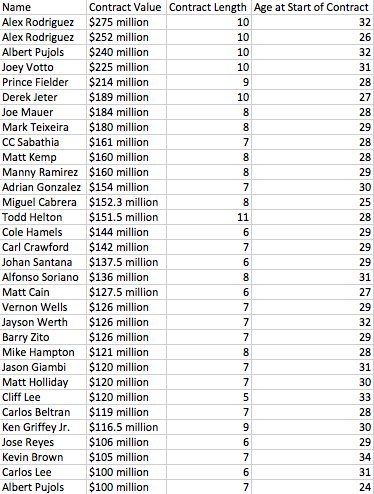
Chart of players with $100 million contracts

This ushers in a very interesting question: how did the Yankees end up in this unenviable situation? After opting out of his 10-year contract in 2007, A-Rod and Scott Boras somehow convinced the Yankees–the only team on the market who could afford the slugger–to give Rodriguez yet another 10-year deal, this time worth $23 million more.

Despite the fact that only premier athletes earn $100 million contracts, a sad truth in baseball is that nine-figure deals rarely work out well for the team. Contracts to players like Barry Zito, Vernon Wells, and Jayson Werth (all ironically with 7-year, $126 million deals) are already among the worst in the league, and Prince Fielder’s 9-year, $214 million pact looks like a ticking time bomb with Fielder destined to be a DH in four to five years.

There have been 32 total contracts of at least nine figures in baseball history, but the success rate certainly isn’t good. Maybe that’s because 12 of those were players at least 32 when they signed, including four whose contracts expire after they turn 40. Maybe it’s because only eight of the twenty-five hitters play prime, non-corner defensive positions.

Or maybe, just maybe, $100 million deals rarely work out because by the time players hit free agency, they are normally at the tail end of their prime. So during the length of their blockbuster deal, the team gets declining results at increasing costs. Take a look at the numbers.

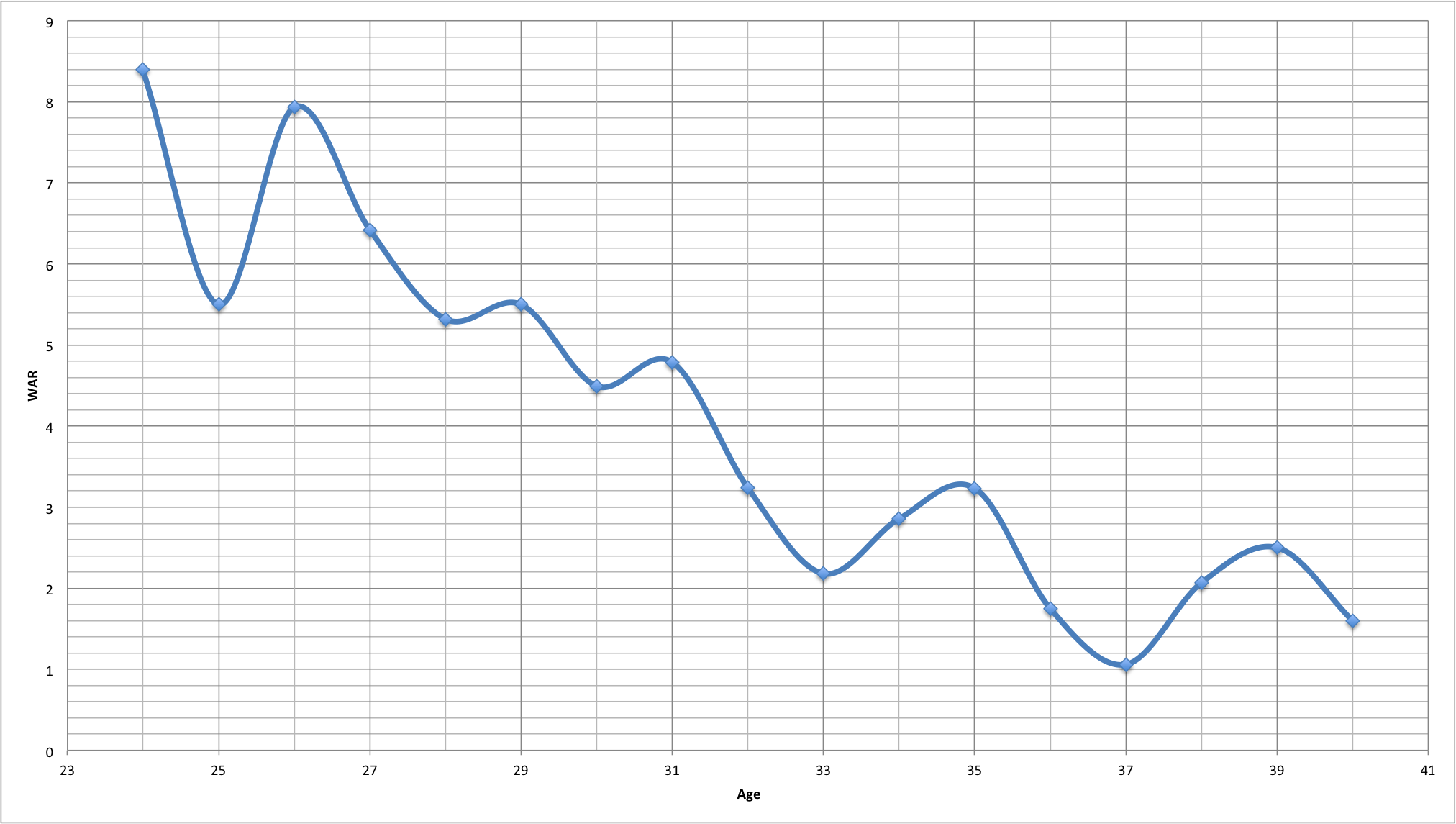
Graph of WAR vs. Age for players during $100 million contracts.

This graph shows the WAR for every player under a nine-figure contract at each age. Obviously, there’s a clear pattern that WAR and overall play decreases starting as early as age 26. The regression line for the relationship between WAR and age for these nine-figure players comes out to be a nice equation:

WAR = 16.875 – 0.402*Age          R2 = .838

Now, this function is only viable for ages between 24 and 40, since it can be dangerous and assumptive to extrapolate beyond the data set, but the data is very interesting. According to the regression line, $100 million players should drop 0.4 every season. Additionally, 83.8% of the change in WAR can be attributed to age.

To put this in perspective, players given a 10-year contract are projected to have four less WAR in the final season of the contract than than they will at the start of the contract. Albert Pujols produced 5.0 WAR in the final season before his new contract , so under this model, one would expect the final season of his 10-year contract to have 1.0 WAR. To make matters worse, Pujols is due $30 million that season.

Since almost every current contract is backloaded, players have decreasing production while earning an increasing salary.

Some may argue that deep-pocketed teams have a huge advantage over smaller market teams because the Tampa Bays and the Pittsburghs of the world can’t just hand out $100 million contracts, and that is true to an extent. But the ability to spend money doesn’t make a team better, especially when the vast majority of players available in free agency are 30-year old post-prime players.

For non-Yankee teams, signing a player to an inevitably failing nine-figure deal can cripple the organization. Joe Mauer has only compiled 6.5 WAR over the past two seasons, and the Twins still owe him $138 million over six years. Because of that behemoth sum of money, the Twins likely won’t be able to sign another premier player until Mauer’s contract runs up, especially since the team lost 195 games over the past two seasons.

The most effective way to spend money still remains to be developing talent within the minor leagues and acquiring young players. Thanks to arbitration rules, players under 28 really don’t get paid all that much comparatively. And considering the best years of players’ careers come around ages 26-29, it really doesn’t make sense to pay extravagant sums for very good players in decline.

Let A-Rod’s recent play be a lesson to all teams thinking about signing players to blockbuster deals (or in the Dodgers’ case, trading for players with $100 million deals). It may hurt to let a great player go, but there are far more effective ways of spending money than doling out a 10-year contract to a 30-year old first baseman.

Categories: MLB | 6 Comments

A Strasburgian Failure

The baseball world has been buzzing about two young players this entire season. Mike Trout and his ridiculous 8.7 WAR (over 22% better than any other player) is sending media and fans everywhere into a frenzy, but the more interesting story may be Stephen Strasburg’s pitching dominance before subsequently being shut down for the season.

We’ve always known that Stephen Strasburg probably wasn’t going to pitch a full season. The Nationals made that clear; they didn’t want to overuse their young pitcher. But what we didn’t know is that the Nationals were going to be this good, all but a lock for postseason play.

Back in Spring Training, the Nationals announced that  Strasburg would have an innings limit but didn’t explicitly say what that limit was. They made a similar move last year with Jordan Zimmermann coming off Tommy John Surgery, who pitched 161.1 innings before being shut down at the end of August. As it turns out, Strasburg’s season ended even before he reached that mark, finishing last Thursday with 159.1 innings pitched.

The Nationals have been in first place since May 22nd, but they haven’t changed their strategy for handling Strasburg at all. Maybe that’ll pay off in the future with a long, healthy career for Strasburg, but we’ll never know if saving him now really makes a marked difference. All we do know is the Nationals likely aren’t going to win the World Series without their ace.

Let’s not forget that Stephen Strasburg has one of the greatest unheralded nicknames of all time: Anchorman.

Assuming the Nationals are telling the whole truth about Strasburg being shut down for the year, I think they’re making a big mistake. Not only that, they’ve been completely uncreative in the process. Let’s take a look at what the Nationals could have done to allow Strasburg to pitch further into the season.

My first problem with the Nationals decision to shut down their ace is that pitching an extended amount of innings hasn’t been proved to cause injuries. Really, the more concerning total is pitches per outing (see Prior, Mark and Wood, Kerry). It wasn’t until about the turn of the century that teams really started tracking pitch counts, and younger pitchers are getting hurt at a much lower rate since 2000.

Smartly, the Nationals haven’t been overusing Strasburg in single games. He’s averaging just over 93 pitches per start and has only crossed the 100 pitch threshold in 10 of his 28 starts. Even his season high 119 pitches came on a game with five days rest.

I have an inkling, though, that the Nationals actually did cap Strasburg by a pitch total, not an innings total. It’s just easier to tell reporters that he’ll pitch 160 innings rather than 1600 pitches–it’s just a nicer number. Also, not every inning is created equal. A three-pitching quickie inning certainly puts less stress on a pitcher’s arm than a laborious four-run thirty-pitch inning.

But for now let’s assume that Nationals upper management decided that Strasburg isn’t going to throw more than 160 innings this season. There are still ways to keep him pitching throughout the year.

Once the Nationals took over first place nearly three months ago, they should have adjusted Strasburg’s schedule a bit. There’s no reason to use up all his starts in the regular season when all you can win in the first 162 games is a division crown. That’s nice and all, but the playoffs is a little higher stakes–the World Series is on the line.

There are some rather simple ways to save Strasburg’s arm. You could have the man throw 70 pitches or 5 innings before pulling him. The Nationals have an incredibly deep bullpen with Tyler Clippard, Drew Storen, Sean Burnett, Craig Stammen, and crew, so having the ‘pen cover four innings shouldn’t be an issue. Alternatively, they could also match Strasburg up with a piggyback starter to take the last four innings of every start–say Ross Detwiler or John Lannan.

If they’re really feeling creative, they could pitch Gonzalez, Zimmermann, and Jackson 1-2-3, then go with Strasburg in the 4th game followed by Detwiler. Then in the next rotation go Gonzalez, Zimmermann, and Jackson, followed by Lannan then Strasburg, giving him five days rest between starts. In the next rotation go Gonzalez, Zimmermann, and Jackson followed by Detwiler and Lannan. Rinse and repeat. Strasburg makes two starts every three rotation cycles with starts on five and eight days rest.

Washington could have even follow that schedule at limit him to 70 pitches per outing. They could skip some of his starts or just shut him down for two weeks at a time. They could have ended his season two starts earlier and just saved him for playoff baseball. There are so many ways to use Stephen Strasburg’s 160 innings while still having him in the playoffs, yet the Nationals didn’t have the inginuity to come up with anything other than prematurely curtailing his season.

I hope the Nationals ran through more options than just pitching their young ace for 160 straight innings. I really hope they do. Because if the Nationals make an early exit in the playoffs because of a lack of pitching, their failure to come up with creative solutions may come back to haunt them for years to come.

Categories: MLB | Leave a comment

So… About the Red Sox

Back in April, I wrote about how it was way to soon to freak out about the Red Sox. They started 4-10 against a brutal schedule with a rash of injuries, but that was way to early to give up on an incredibly talented team. I still stand by what I said nearly five months ago.

But things didn’t get better. They got a lot worse. Bobby Valentine could not take control of a clubhouse full of crazy characters, which eventually led to the dumping of Kevin Youkilis for a couple of spare parts. Carl Crawford took much longer to come back from wrist and elbow injuries than expected, then only played 31 games before being shut down with Tommy John Surgery. David Ortiz injured himself running the bases. No starter had an ERA under 4.50.

There is a bright side to this season, though, as strange as it sounds. The Red Sox won’t finish with a great record this year, and they probably won’t be great next year, either. But they’ve freed up around $260 million from the Gonzalez/Crawford/Beckett trade, which opens up all sorts of possibilities.

In the NBA and NFL, teams can tank for a better draft pick. Suffering through a long season is worth it if you end up with Anthony Davis or Andrew Luck. The real reason this works is because being all playoff teams have one thing in common–none of them are in the playoffs (obviously). And if you aren’t in the playoffs, you might as well aim for a great draft pick.

However, in the NBA and NFL, draftees make an immediate impact. Cam Newton improved the Panthers by five games last year, and Cleveland’s winning percentage increased 86 points with Kyrie Irving. But in baseball, on the other hand, we don’t get to see the fruits of each team’s draft immediately.

It’s not that tanking in baseball doesn’t work–the worst teams definitely get the best pick–but the return for one bad season isn’t great. We’re talking about adding one potentially good player three to five years in the future in a sport in which one player does not make a huge difference.

Still, it looks like the Red Sox have gone full-blown-Bobcats on us. David Ortiz and Will Middlebrooks have already been shut down for the year, and who knows, maybe Boston’s brass is being a little too cautious and over-protective of their players. Hell, they even acquired Scott Podsednik twice. And in full consciousness, they batted him third.

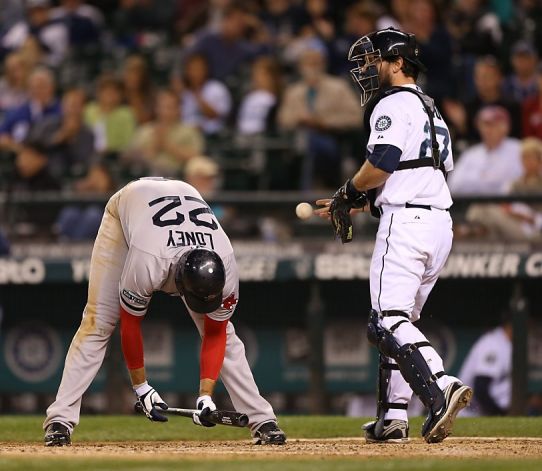
No team starts James Loney every day at first base unless they’re trying to lose.

Now I’m not saying they’re purposely tanking, but I’m not saying they’re trying to win. Yeah, it’s a strange team, indeed. Buster Olney even reported on Monday that agents of Red Sox players were upset with how their clients were being utilized.

All of a sudden the Red Sox have the 9th worst record in the league. In other words, the 9th pick in next year’s draft. They’re just 2.5 games ahead of (behind?) the 6th-worst Marlins and just 6.5 games away from the 3rd-worst Twins. With 24 game to go, the Red Sox are in range of some really sweet picks.

Maybe the Red Sox have found a new market deficiency in bottoming out for a year or two, collecting great draft picks. That’s certainly a better plan than the the market deficiency they found this winter: trading off all your shortstops. Or maybe they’re just making the most of a bad situation. They’re not making the playoffs this year, so why not gun for a better draft pick?

Categories: MLB | Leave a comment

The Knuckle Cast

I just wrote another article for the Charlotte Observer on Ty Buttrey and Brad Stone–two Charlotte High School pitchers–and their different paths to the MLB Draft, but I felt like there was more to the players’ stories than I couldn’t cover in the 602 word article.

And because of that I decided to make a podcast for the first time, which is fittingly titled The Knuckle Cast. This first episode is my interviews with the two players and will be the first of hopefully many podcasts to come–although I can’t promise regular episodes.

I’ve made a page with an archive of all (one) episodes, which I’ll update each time a post a new podcast.

It will probably be slow to load at first, but please check it out and let me do what I can do to improve The Knuckle Cast.

The Knuckle Cast Episode #1

Categories: MLB, Podcasts | Leave a comment

Dial Up The Robot Umps

Some call it the human factor. I call it human error.

Over and over, we’ve seen games riddled with blown calls by umpires, and it’s not as if there’s nothing we can do about it.

Just in the last few seasons, we’ve had a blown call ruin perfect game, a blown call save a no-hitter, a groundout with the first baseman three feet off the bag, and an extra inning playoff double ruled foul.

It’s infuriating to watch from the stands or the couch and know that a potential game-changing call was wrong. Oftentimes, it’s as if the umpire is the only person in the world who thinks the call was made correctly.

Major League Baseball finally added instant replay in late August of 2008, a move far overdue for the nation’s pastime. I don’t want to say that Bud Selig has been a bad commissioner because of how he’s handled steroid suspensions versus DUI suspensions, but he certainly hasn’t been a very progressive commissioner.

After all, he’s following the worst line of reason around: We’re not making a change because this is the way we’ve always done things.

Change is a good thing. Change has brought us interracial marriage, DVR, and pepperoni P’Zones.

I’m a mathematical guy, so naturally I like things to be precise. I don’t like when picture frames are rotated two degrees too far clockwise, so you can bet I really don’t like it when a second base umpire messes up a stolen base call.

Fifteen years ago, there was an excuse for the lack of instant replay. There weren’t HD cameras, for one. But now, we have nearly a dozen camera angles for every play on some extremely precise cameras. We have the technology at our fingertips, yet Bud Selig has resisted the spoils of modern technology.

One of the main complaints of anti-replay fans is that consulting replay would take too long. As if Red Sox-Yankees marathons weren’t long enough as is, imagine them taking five-minute breaks every inning to check over every other call. Well, that’s not exactly the case. If you caught the Sawx-Yanks game on July 29th, you’d see it a different way.

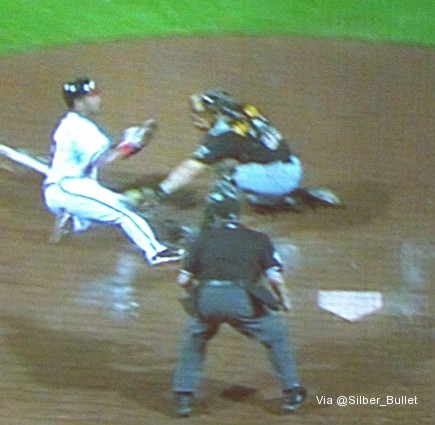
With no outs and a runner on first in the top of the tenth, Will Middlebrooks came up to bat, squared to bunt. The second pitch of the at-bat was way inside, and as Middlebrooks brought back in his bat, the pitch hit him in the wrist. Unfortunately, the ball deflected straight into home plate umpire, Brian O’Nara.

O’Nara couldn’t make the call, as he laid on the ground in pain. The other umpires were all 100 feet away from home plate, so they didn’t have a good angle. But the umpires huddled up for about five minutes discussing what they thought they had seen. We have access to super slow motion, 1080p video from endless angles, yet baseball has resorted to four men discussing their views from afar. But that’s just the beginning.

Middlebrooks was angry because he was showing off the mark on his wrist made by the ball, but the umpires wouldn’t look. Bobby Valentine, however was even more angry since he got to see the replay in the dugout. Bobby V then spent the next five plus minutes yelling at the umpires before fruitlessly getting ejected.

On that one play alone, the umpires and manager wasted 10 minutes, when a brief look at one instant replay could have correctly sent Middlebrooks to first base.

This game-winning run couldn’t be reviewed because that would obviously ruin the integrity of the game.

With access to instant replay, Major League baseball could cut down the amount of missed calls nearly to zero at the same time as they save time and collateral damage, in the form of ejections.

But what blows the mind most about the current instant replay rules is that the most important play in all of baseball–run scoring plays–cannot be reviewed. Sure, checking if a fan touched a fair ball could significantly alter a game, but there’s nothing more crucial than a play at the plate. After all, you do win games by scoring more runs than the other team.

My rules for instant replay would be very simple. 1) Have a fifth umpire in the press box with access to instant replay. 2) Give each team two challenges per game, and if the play is overturned, they get to keep the challenge. 3) Challenge anything that’s not balls and strikes. 4) Cook for 30 minutes, then let it cool.

And you know what, I’d even be fine with robot umpires behind home plate using K Zone. Maybe then we wouldn’t have blatant miscalls based on payback, such as what sparked Brett Lawrie’s terrific tirade earlier this season.

But have no fear, sports fans, Commissioner Selig is coming to the rescue! Earlier this week he told Mike Lupica he’s confident replay will be expanded to include trapped balls and balls hit down the line… but not before 2013. He also added he would be “very cautious” to make any more changes.

Clearly it’s going to take a new commissioner for MLB join the modern age of technology. And I hope that change comes sooner rather than later because I’d hate to see change spurred on by a playoff game marred by a blown call.

_

Also check out my newest article for the Charlotte Observer: Tigers rugby club finds early success.

Categories: MLB | Leave a comment

Charlotte Observer and Bobcats Baseline Update

Earlier this summer I interned at the Charlotte Observer and got three articles published. Now I’m freelancing with the paper–specifically with the South Charlotte News sports section–so I’ve created a page with a link to all of my articles. Quickly, my three published articles so far are:

Also, I’ve had two more articles published at Bobcats Baseline, which are:

Keep checking in on The Knuckle Blog and my Charlotte Observer and Bobcats Baseline pages, and don’t forget to spread the word!

Categories: MLB, NBA, NFL | Leave a comment

Baseball is Better Off Without Divisions

Life isn’t fair because there’s too much we can’t control. But when there’s something unfair that we can control, it’s time for a change.

Major League Baseball has had two separate leagues since its inception, and each league was split into East and West divisions starting in 1969. Twenty-five years later, a Central division was added to each league, and a wild card spot allowed a non-division winner into the playoffs for the first time in the league’s history.

Win your division, and you’re in the playoffs. It doesn’t matter the circumstances, just win your division. That’s the way it’s always been, and after all, baseball is a game of tradition.

But what are divisions? They’re just groups of five generally geographically close teams.

Moreover, divisions aren’t equally balanced groups of five teams; they’re just five arbitrarily placed together teams. So to say that a team needs to be better than four other arbitrarily picked teams to make the playoffs would just be unfair.

Most of that “unfairness” is eliminated with the addition of a wild card. In four of the last five seasons, the AL East has been home to two of the three best teams in the American League, but thanks to the Wild Card both teams have qualified for the postseason.

But sometimes teams aren’t so lucky. The best five teams record-wise don’t always get to the playoffs because the divisions are often not equally talented.

If the season ended right now, the Angels, owners of the fifth best record in the AL, would not make the playoffs. Their record is 38-32, but the Indians are leading the AL Central with a 36-32 record, so Cleveland would be the team playing into October.

Sure, we’re not even half way into the 2012 season, but situations like the Angels’ predicament have happened plenty of times before. In fact, they’ve happened not so long ago.

In 2009, the Rangers finished second in the AL West with an 87-75 record, good for fourth best in the AL. But Minnesota and Detroit were locked up at 86-76 atop the AL Central, so they had a one-game playoff to see who would advance to the postseason. Texas was just out of luck.

Basically the same situation played out the year before with the Yankees finishing third in the AL East with an 89-73 record—the fourth best in the AL. Chicago and Minnesota were each 88-74, so Chicago made the playoffs after winning their 163rd game of the season.

But that wasn’t even the most extreme example of unfairness from that 2008 season.

The Los Angeles Dodgers won the NL West that year with an 84-78 record. Three other National League teams (the 89-win Mets and the 86-win Astros and Cardinals) finished with more victories than the Dodgers. And that’s not even considering the Marlins, who also finished with 84 wins, despite playing one less game.

Naturally, the Dodgers deserved to make they playoffs because they had the best record in a group of five arbitrarily grouped teams.

And worst of all is the 2005 San Diego Padres. They won 82 of their 162 games, but qualified for the postseason because the other four teams in their division could only muster 77, 75, 71, and 67 wins.

San Diego got to feast on the worst division in recent memory, while the NL East saw it’s worst team (Washington) finish 81-81. MLB schedules have each team play 45% of their games against divisional teams—San Diego got a bunch of cupcakes, while the NL East teams spent nearly half their schedule beating themselves up.

Baseball is rearranging their schedule next season when the Astros switch from the NL Central to the AL West. But I suggest that MLB changes the landscape of the league ever further for the 2013 season. I think that they should completely do away with divisions.

Eliminating divisions entirely would do two things to help equity in baseball. One, it would remove the unbalanced schedules that hurts teams in overly-competitive divisions. Two, it makes sure that the teams with the five best records make it to the postseason.

For years, the Toronto Blue Jays have been in a mess of trouble if they wanted to make the postseason. It’s not just that they’re fighting an uphill battle trying to finish the year with a better record the Yankees, Red Sox, and Rays. They also have to spend 9 out of every 20 game playing these tough opponents before they play out-of division teams.

Brett Lawrie is really angry because his Blue Jays have a doubly hard time making the playoffs since they're stuck in the AL East.

Some teams, like the 2011 Tigers for example, have that 45% chunk of their schedule against just terrible opposition. After Detroit, no other team in the division had a winning record.

The Tigers played that 45% of their schedule against divisional teams with a dismal .452 winning percentage. I bet Toronto would have killed for that instead of their brutal schedule of teams with a combined .535 winning percentage.

Now that there are fifteen teams in each league, every day will have at least one interleague game. So with that in mind, why not give ever team an even schedule? Each team can play two-thirds of their games against the other fourteen teams in their league with the last third being interleague games. No team faces an unnecessarily hard schedule, and nobody gets a Boise State-style cakewalk schedule.

With balanced schedules and no more divisions, MLB would basically ensure that the the five best teams in each league would make the playoffs. No more 82-win division champs. No more crazy tough schedules.

What’s there to lose? Sure, there will be fewer Red Sox/Yankees games, but that will make each matchup mean more. And yes, there will be longer flights, but teams can have extended road trips to visit geographically close teams in a row (a 12-day road trip against the Cubs, White Sox, Brewers, and Twins).

And when it all comes down to it, I’d rather have a profitable sports league spend a bit more on travel to have a more fair way to pick playoff teams.

Categories: MLB | Leave a comment

Wait, Is That Mark Prior?

It’s hard to forget Mark Prior. He dominated baseball at the highest level, but he’s now known more so for what could have been.

Check out Wikipedia, and it says that “he is also best known for a string of injuries that halted his major league career.”

Prior was drafted second overall behind Joe Mauer in the 2001 amateur draft, and he received a whopping $10.5 million signing bonus—a record that stood until Stephen Strasburg happened. Prior only needed nine starts in the minors before earning a callup to the Bigs.

And he dominated. Boy, did he dominate.

Prior made 19 starts in his rookie season and posted a 3.32 ERA with 147 strikeouts and just 38 walks in 116.2 innings. His season, though, was cut short when he strained a hamstring while running the bases.

2003 came along, and he put up even more dominating numbers. A 2.43 ERA. 245 strikeouts in 211.1 innings. Just 50 walks and a miniscule 1.10 WHIP. He was named to an All-Star game after just over a full season of big league play.

But Prior didn’t end up playing in the All-Star game. Just before the All-Star Break, he collided with Atlanta’s Marcus Giles, and Prior missed the Mid-Season Classic along with three additional starts.

Although he wouldn’t miss any more starts that season because of injuries, 2003 was the beginning of the end for Prior’s career.

The Cubs won the NL Central, thanks to heavy use of their young pitching duo of Prior and Kerry Wood. And I mean heavy use of Prior and Wood. Prior averaged over 113 pitches per start in the regular season, including 126 pitches per start in September. Come playoff time, Prior averaged 120 pitches per start.

Of course, you know the story of how the 2003 playoffs went. The Cubs were up 8-3… Steve Bartman… 8 run Marlins rally… Florida takes Game 7… blah blah blah.

But after logging so many innings and tossing so many pitches in his second season, Prior never quite looked the same. He made 59 more starts over the next three seasons, but he sported a 4.27 ERA with growing walk rates and shrinking strikeout rates. Not only that, but he faced six different injuries from Achilles to elbow to shoulder to oblique.

Prior’s 2007 campaign ended before it even got off the ground when he had to have shoulder surgery after one minor league start. For the Cubs, that was enough frustration for a century, and they non-tendered him that off-season, granting him free agency.

Prior attempted a comeback with his hometown Padres for the 2008 season, but another shoulder tear ended that fairy tale. Fate wasn’t in his favor for his second attempted return to the majors with San Diego, as he wasn’t healthy enough to throw a single pitch in a game either season.

He again tried comebacks in 2010 and 2011 with the Texas Rangers and New York Yankees, respectively, but he only managed to pitch a combined 24 innings for both minor league systems. The one thing he did manage to do, though, was add a groin injury to his laundry list of maladies.

Mark Prior's starting career is over, but he can still be a valuable reliever.

All of this brings us to Prior today. Coming out of the Pawtucket Red Sox bullpen, he doesn’t have his same blazing fastball, but he can still put on a show.

It’s a small sample size, but Prior is showing some serious promise. In five relief appearances, he’s racked up 15 strikeouts in 6.2 innings with three hits, four walks, and most importantly no earned runs.

With that said, the Red Sox are being extremely cautious, and rightfully so. Prior has been given off three to four days off between relief appearances, and he’s never faced a more than eight batters in an outing.

But this provides hope—not just for Prior, but for pitchers who’ve seen their careers decimated by injuries. Pitchers like Ben Sheets. And pitchers like Jon Garland. It’s unlikely that any of those three former workhorses will ever start more than a few major league games again—although Sheets threw for four teams on June 13th—but all three could become major leaguers down the road.

Those three are all still relatively young (Prior is 31, Garland 32, and Sheets 33), so they still have something left in the tank. Injuries will prevent them from remaining starting pitchers, but they can still be valuable relievers.

Pitchers like Prior can follow the mold of Alfredo Aceves. No, not the “closer” with the 4.81 ERA from this season, but the Jack of all Trades reliever who could fit into any role from 2011.

Last year, Alfredo Aceves logged 112 innings. He was the team’s mop-up man, one of the most trusted set-up guys, twice earned saves, and even made four spot starts. Whatever the Red Sox needed, he gave them.

Just because pitchers like Prior, Sheets, and Garland haven’t pitched in the majors in years doesn’t mean they’re completely done. All team can use more pitching depth, and nearly every contender seems to be looking for bullpen help at the trade deadline.

With tempered expectations, patience, and caution to injuries, Mark Prior and pitchers of his ilk can still make an impact at the major league level. Just look at how Prior’s former teammate Kerry Wood reinvigorated his career as a reliever in the last six seasons.

Categories: MLB | Leave a comment

Create a free website or blog at WordPress.com.