Author Archives: benweinrib

So… About the Red Sox

Back in April, I wrote about how it was way to soon to freak out about the Red Sox. They started 4-10 against a brutal schedule with a rash of injuries, but that was way to early to give up on an incredibly talented team. I still stand by what I said nearly five months ago.

But things didn’t get better. They got a lot worse. Bobby Valentine could not take control of a clubhouse full of crazy characters, which eventually led to the dumping of Kevin Youkilis for a couple of spare parts. Carl Crawford took much longer to come back from wrist and elbow injuries than expected, then only played 31 games before being shut down with Tommy John Surgery. David Ortiz injured himself running the bases. No starter had an ERA under 4.50.

There is a bright side to this season, though, as strange as it sounds. The Red Sox won’t finish with a great record this year, and they probably won’t be great next year, either. But they’ve freed up around $260 million from the Gonzalez/Crawford/Beckett trade, which opens up all sorts of possibilities.

In the NBA and NFL, teams can tank for a better draft pick. Suffering through a long season is worth it if you end up with Anthony Davis or Andrew Luck. The real reason this works is because being all playoff teams have one thing in common–none of them are in the playoffs (obviously). And if you aren’t in the playoffs, you might as well aim for a great draft pick.

However, in the NBA and NFL, draftees make an immediate impact. Cam Newton improved the Panthers by five games last year, and Cleveland’s winning percentage increased 86 points with Kyrie Irving. But in baseball, on the other hand, we don’t get to see the fruits of each team’s draft immediately.

It’s not that tanking in baseball doesn’t work–the worst teams definitely get the best pick–but the return for one bad season isn’t great. We’re talking about adding one potentially good player three to five years in the future in a sport in which one player does not make a huge difference.

Still, it looks like the Red Sox have gone full-blown-Bobcats on us. David Ortiz and Will Middlebrooks have already been shut down for the year, and who knows, maybe Boston’s brass is being a little too cautious and over-protective of their players. Hell, they even acquired Scott Podsednik twice. And in full consciousness, they batted him third.

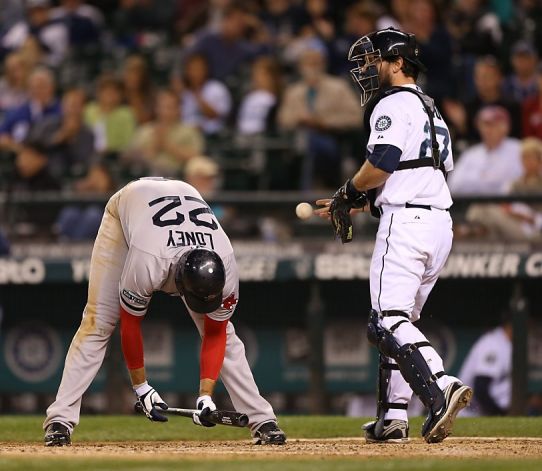
No team starts James Loney every day at first base unless they’re trying to lose.

Now I’m not saying they’re purposely tanking, but I’m not saying they’re trying to win. Yeah, it’s a strange team, indeed. Buster Olney even reported on Monday that agents of Red Sox players were upset with how their clients were being utilized.

All of a sudden the Red Sox have the 9th worst record in the league. In other words, the 9th pick in next year’s draft. They’re just 2.5 games ahead of (behind?) the 6th-worst Marlins and just 6.5 games away from the 3rd-worst Twins. With 24 game to go, the Red Sox are in range of some really sweet picks.

Maybe the Red Sox have found a new market deficiency in bottoming out for a year or two, collecting great draft picks. That’s certainly a better plan than the the market deficiency they found this winter: trading off all your shortstops. Or maybe they’re just making the most of a bad situation. They’re not making the playoffs this year, so why not gun for a better draft pick?

Categories: MLB | Leave a comment

The Knuckle Cast Episode #2

The second ever episode of The Knuckle Cast has arrived! This week I interviewed Vanderbilt redshirt senior Archie Barnes, a captain of the football team, and I’m posting it here for everyone to hear. Again, the audio quality isn’t great, but Archie’s story is.

I used this interview in an article for the Vanderbilt Hustler, which you can check out here.

I hope you enjoy this podcast, and I’m open to any and all comments and recommendations.

The Knuckle Cast Episode #2

Categories: Podcasts | Leave a comment

A Brief Thank You

I’ve been blogging now for over three years–1240 days.

I’ve been writing an annual baseball preview since the winter of 2006–over 2000 days.

I’ve known I want to be a sportswriter since the end of my freshman year in high school–over 1000 days ago.

And now that I’m starting my freshman year at Vanderbilt University, I think it’s time to thank a few people that have helped me get to this point.

First and foremost, I need to thank my parents. They’ve supported me through and through and, you know, I really wouldn’t be here without them.

Next we have my brother, Michael. We’ve had more than our fair share of brotherly love, but he’s always there for me.

I can’t forget the rest of my family. To my grandparents Mike and Louisa and my great-grandma Hermine, thanks for sharing your love of baseball with me. To my Uncle Dan, thanks for helping edit my baseball previews and all the conversations–baseball and more. To cousins Claire and Jack plus Uncle Stephen and Aunts Lynne, Karen, Sara, and Kim thank you all for the support, love, and encouragement.

To my teachers, thank you for pushing me to learn more and do more. To Mr. Scully, who pushed me to start blogging and answered every last one of my questions about technology, thank you. To Mr. Kutner, who made me a much better writer even if it meant writing such encouraging comments as “Ugh,” “Blah,” “Barf,” and “Gross,” thank you. To Mr. Lucia, for pushing my mind in math, helping me create a baseball player ranking system, and carrying on long-lasting debates, thank you. To Mr. Jon Downs for helping me off the bat with my journalistic writing and Mr. Jesse Downs for encouraging me to go to Vanderbilt, thank you.

And to my Providence Day School lower school teachers–Mrs. Cook, Warwick, Schultz, Highfield, Akbari, Lambeth, Pleasant, Cook, and Blackwell–and my Providence Day School middle school teachers–Mrs. English, Bynum, Parker, Bard, Pierce, Villegas, Fisher, Edelman, Osborne, Barlow, and White, and Mr. Harper, Sienkowski, Burgess, Borcich, Field, Burnam, Hawk, and Henry–and the rest of my Providence Day School upper school teachers–Mrs. Coley, Whelan, Caldwell, Sivy, and Hinson, and Mr. Tappy, Hedinger, Welsh, Taylor, Reeder, Turner, Boyer, Bynum, Garrison, Dickson, Grabenstetter, Werner, Nichols, Finneyfrock, Erb, Hough, and Kashatus–thank you for everything.

To my baseball coaches: thank you Coach Cerbie for pushing me harder than I’d like in practice, thank you Coach Smith for helping me appreciate the intricacies of pitching, and thank you Coaches Wallace and Bibby for keeping things fun in JV. And my teammates? Thanks for seven great years.

I was blessed to be able to work with the Charlotte Observer this summer, thanks to Providence Day School. I got to work with some really great people–with whom I will hopefully be able to work again in the future–Corey Inscoe, Jim Walser, Mike Persinger, Scott Fowler, Harry Pickett, and more.

Thanks to the guys from Bobcats Baseline–Adam Sakoonserksadee and Dr. Ethan Musgrove–for giving me a chance to write for another great website and helping out my writing.

Thank you my great friends from school, baseball, and beyond–specifically my friend Ben Hinson, with whom I played baseball since tee-ball, and my six fellow Providence Day Chargers headed to Vanderbilt: Andy Marx, Chris Nash, Emily Stewart, John Cambern, Katie Metzger, and Tommy O’Gorman (and here’s to four more great years).

Thank you to my amazing family on Twitter; I’ve made some incredible friends over my three years and nearly 36,000 tweets. I’m talking about you, @SydDaKid17, @CardboardGerald, @jmiller112, @atjared, @bmb21, @JayMaalD, and more. (Tweet at me @benweinrib if I forgot about you).

Thank you to the writers on The Charger, and even more recently the secret society of cunning linguists at Charging Backwards–Holy Broman Empire, The Broletariat, Edgar Allen Bro, Broseph Stalin, Broseiden King of the Brocean, and Brosiah Wedgwood–for making writing so much fun.

Thank you to the pro athletes I’ve been lucky enough to interview with during my time in high school: Delino DeShields Jr., Joe Borchard, Ty Buttrey, Brad Stone.

I wouldn’t be here right outside my dorm room in Stambaugh House if not for the admissions crew at Vandy, and I wouldn’t be nearly as happy if it were not for the TRA, who helped award me the Fred Russell-Grantland Rice Sports Writing Scholarship. I can’t thank those guys enough.

I’ve had so many great opportunities and so many people to thank.

Hopefully I can look back and say this is the beginning of great things. And I wouldn’t be here without all this help.

Categories: Other | 1 Comment

The Knuckle Cast

I just wrote another article for the Charlotte Observer on Ty Buttrey and Brad Stone–two Charlotte High School pitchers–and their different paths to the MLB Draft, but I felt like there was more to the players’ stories than I couldn’t cover in the 602 word article.

And because of that I decided to make a podcast for the first time, which is fittingly titled The Knuckle Cast. This first episode is my interviews with the two players and will be the first of hopefully many podcasts to come–although I can’t promise regular episodes.

I’ve made a page with an archive of all (one) episodes, which I’ll update each time a post a new podcast.

It will probably be slow to load at first, but please check it out and let me do what I can do to improve The Knuckle Cast.

The Knuckle Cast Episode #1

Categories: MLB, Podcasts | Leave a comment

A Dream Team Nightmare Debate

The debate has been going on for weeks now. Which team is better: the ’92 Dream Team or the 2012 team?

Now this debate is dumb for several reasons. One, we’ll never know which team is better since they can’t actually play each other, and two, it’s just a stupid debate.

But because it’s a stupid debate, I’m going to use up 827 words to throw my opinion into the ring.

Here we go.

Team USA won the gold medal Sunday, reaffirming that the team with 12 of the 41 NBA players in the Olympics was the best. Now no other country had more than six NBA players, which helps explain why the US won their eight game by more an average of over 32 points.

The original Dream Team, however, won their eight games by an average of nearly 44 points, so they’re clearly the better team, right? Well, not exactly.

The Dream Team had eleven NBA players plus Christian Laettner, but the rest of the world barely had any. I’m talking just Drazen Petrovic, Toni Kukoc, Sarunas Marciulionis, and Stojko Vrankovic. (Shockingly, I didn’t make up any of those names)

But that ’92 team wasn’t just dominant because they had more NBA players than the rest of the countries combined; the other countries feared playing them. And if they didn’t fear the Dream Team, they were just excited to be on the same court.

Conversely, international players were calling out the 2012 Dream Team left and right. Marc Gasol called out the team first before the Olympics even started, and Nicolas “Nutcracker” Batum joined in during the Summer Games.

Just because one team was revered and one team wasn’t doesn’t prove one was better than the other. 82% of RottenTomatoes.com users liked the first Twilight movie compared to 33% of users liked MacGruber, but I’ll always maintain that MacGruber is the far better movie.

To be clear, I do think the 1992 team would beat the 2012 team. Probably. But a lot of that has to do with the fact that the current Dream Team is missing a four key players. Give me Dwight Howard, Derrick Rose, Dwyane Wade, and Chris Bosh, and this is a different conversation.

Let’s look at things a different way.

Athletes have gotten much better over time. Jesse Owens ran his historic 1936 100 meter dash in 10.3 seconds. He would’ve finished a distant 8th in the 2012 Olympics because Asafa Powell somehow ran an 11.99, well beyond 7th place Richard Thompson’s 9.98 time.

Even in 1992, Linford Christie won gold with a 9.96 100 meter time. That barely edges out Thompson to get 7th place in 2012.

Simply put, today’s athletes are bigger, faster, and stronger than the athletes of yesteryear.

Let’s take a look at the 1992 roster vs. my updated 2012 roster to include injured Olympians.

1992 Team

2012 Team

Pos.  Name Height Weight Pos. Name Height Weight
C David Robinson 7’1” 235 C Tyson Chandler 7’1” 240
C Patrick Ewing 7’ 240 C Dwight Howard 6’11” 265
PF Christian Laettner 6’11” 235 PF Chris Bosh 6’11” 235
PF Karl Malone 6’9” 255 PF Kevin Love 6’10” 260
PF Charles Barkley 6’6” 250 SF Kevin Durant 6’9” 235
SF Larry Bird 6’9” 220 SF LeBron James 6’8” 250
SF Scottie Pippen 6’7” 220 SF Carmelo Anthony 6’8” 230
SF Chris Mullin 6’7” 215 SG Kobe Bryant 6’6” 205
SG Clyde Drexler 6’7” 220 SG Dwyane Wade 6’4” 220
SG Michael Jordan 6’6” 200 PG Derrick Rose 6’3” 190
PG Magic Johnson 6’9” 220 PG Deron Williams 6’3” 209
PG John Stockton 6’1” 175 PG Chris Paul 6’ 175

We forget that the Round Mound of Rebound was Kobe Bryant’s height. Karl Malone? Just bigger than LeBron, but far slower.

Not only that, but Magic was 32, and Bird was on his last legs at the age of 35. Even Patrick Chewing Ewing and John Stockton were 30.

Nobody outside of Kobe Bryant is over 30 on the 2012 team. At an average age of 27, 2012 Team USA would be in far better shape.

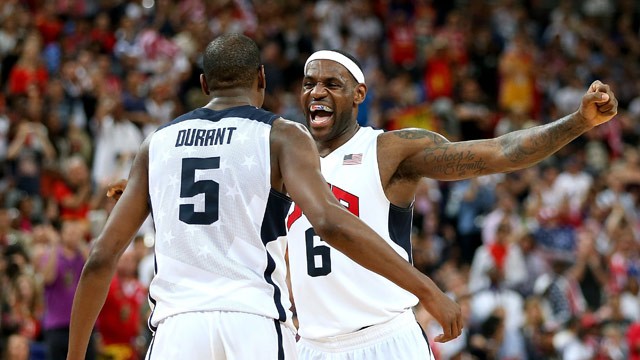
LeBron James and Kevin Durant put up historic Olympic numbers while playing the best international competition we’ve ever seen.

And lastly, the big question is how the new team will match up with the original Dream Team’s big men. Well with the addition of Dwight Howard, that won’t be such a problem. The real question is how the ’92 team would match up against the starting lineup of Chris Paul, Kobe Bryant, Kevin Durant, LeBron James, and Dwight Howard.

Kevin Durant scored at will all Olympics, and LeBron reinforced that he is the best player in the world. Karl Malone can’t guard LeBron. Charles Barkley can’t guard Kevin Durant. There’s clearly going to be a lot of scoring in this game, but I think the younger, more athletic, quicker team will prevail.

I know it’s blasphemy. I know it’s heresy. Michael Jordan’s star has grown and grown since he retired nine years ago until he’s reached a god-like pedestal,. But one player can only do so much with dozens of Hall of Famers playing in one game.

Michael Jordan is the greatest, but in my mind, he’s not enough to overcome a more athletic, better shooting 2012 Dream Team.

Categories: NBA | Leave a comment

Dial Up The Robot Umps

Some call it the human factor. I call it human error.

Over and over, we’ve seen games riddled with blown calls by umpires, and it’s not as if there’s nothing we can do about it.

Just in the last few seasons, we’ve had a blown call ruin perfect game, a blown call save a no-hitter, a groundout with the first baseman three feet off the bag, and an extra inning playoff double ruled foul.

It’s infuriating to watch from the stands or the couch and know that a potential game-changing call was wrong. Oftentimes, it’s as if the umpire is the only person in the world who thinks the call was made correctly.

Major League Baseball finally added instant replay in late August of 2008, a move far overdue for the nation’s pastime. I don’t want to say that Bud Selig has been a bad commissioner because of how he’s handled steroid suspensions versus DUI suspensions, but he certainly hasn’t been a very progressive commissioner.

After all, he’s following the worst line of reason around: We’re not making a change because this is the way we’ve always done things.

Change is a good thing. Change has brought us interracial marriage, DVR, and pepperoni P’Zones.

I’m a mathematical guy, so naturally I like things to be precise. I don’t like when picture frames are rotated two degrees too far clockwise, so you can bet I really don’t like it when a second base umpire messes up a stolen base call.

Fifteen years ago, there was an excuse for the lack of instant replay. There weren’t HD cameras, for one. But now, we have nearly a dozen camera angles for every play on some extremely precise cameras. We have the technology at our fingertips, yet Bud Selig has resisted the spoils of modern technology.

One of the main complaints of anti-replay fans is that consulting replay would take too long. As if Red Sox-Yankees marathons weren’t long enough as is, imagine them taking five-minute breaks every inning to check over every other call. Well, that’s not exactly the case. If you caught the Sawx-Yanks game on July 29th, you’d see it a different way.

With no outs and a runner on first in the top of the tenth, Will Middlebrooks came up to bat, squared to bunt. The second pitch of the at-bat was way inside, and as Middlebrooks brought back in his bat, the pitch hit him in the wrist. Unfortunately, the ball deflected straight into home plate umpire, Brian O’Nara.

O’Nara couldn’t make the call, as he laid on the ground in pain. The other umpires were all 100 feet away from home plate, so they didn’t have a good angle. But the umpires huddled up for about five minutes discussing what they thought they had seen. We have access to super slow motion, 1080p video from endless angles, yet baseball has resorted to four men discussing their views from afar. But that’s just the beginning.

Middlebrooks was angry because he was showing off the mark on his wrist made by the ball, but the umpires wouldn’t look. Bobby Valentine, however was even more angry since he got to see the replay in the dugout. Bobby V then spent the next five plus minutes yelling at the umpires before fruitlessly getting ejected.

On that one play alone, the umpires and manager wasted 10 minutes, when a brief look at one instant replay could have correctly sent Middlebrooks to first base.

This game-winning run couldn’t be reviewed because that would obviously ruin the integrity of the game.

With access to instant replay, Major League baseball could cut down the amount of missed calls nearly to zero at the same time as they save time and collateral damage, in the form of ejections.

But what blows the mind most about the current instant replay rules is that the most important play in all of baseball–run scoring plays–cannot be reviewed. Sure, checking if a fan touched a fair ball could significantly alter a game, but there’s nothing more crucial than a play at the plate. After all, you do win games by scoring more runs than the other team.

My rules for instant replay would be very simple. 1) Have a fifth umpire in the press box with access to instant replay. 2) Give each team two challenges per game, and if the play is overturned, they get to keep the challenge. 3) Challenge anything that’s not balls and strikes. 4) Cook for 30 minutes, then let it cool.

And you know what, I’d even be fine with robot umpires behind home plate using K Zone. Maybe then we wouldn’t have blatant miscalls based on payback, such as what sparked Brett Lawrie’s terrific tirade earlier this season.

But have no fear, sports fans, Commissioner Selig is coming to the rescue! Earlier this week he told Mike Lupica he’s confident replay will be expanded to include trapped balls and balls hit down the line… but not before 2013. He also added he would be “very cautious” to make any more changes.

Clearly it’s going to take a new commissioner for MLB join the modern age of technology. And I hope that change comes sooner rather than later because I’d hate to see change spurred on by a playoff game marred by a blown call.

_

Also check out my newest article for the Charlotte Observer: Tigers rugby club finds early success.

Categories: MLB | Leave a comment

Charlotte Observer and Bobcats Baseline Update

Earlier this summer I interned at the Charlotte Observer and got three articles published. Now I’m freelancing with the paper–specifically with the South Charlotte News sports section–so I’ve created a page with a link to all of my articles. Quickly, my three published articles so far are:

Also, I’ve had two more articles published at Bobcats Baseline, which are:

Keep checking in on The Knuckle Blog and my Charlotte Observer and Bobcats Baseline pages, and don’t forget to spread the word!

Categories: MLB, NBA, NFL | Leave a comment

2012 NBA Mock Draft 3.0

It’s finally here. The 2012 NBA Draft is in less than 24 hours, and here is your guide. These aren’t the players I necessarily would draft with each pick, but it’s a combination of who I feel would be the best pick and what I’ve been hearing about each team.

1

Anthony Davis

PF 6’11” 222 lbs Kentucky 19 Years Old

There’s nothing more I can really add about Anthony Davis. He’s just really, really good. The only interesting thing I can add is this question: would it be more of a surprise for Anthony Davis or Andrew Luck to be a total and utter schlub in the pros?

2

Harrison Barnes

SF 6’8” 228 lbs North Carolina 19 Years Old

Surprise! In a very Bobcatsian move, Charlotte takes another Tar Heel. But this move isn’t so bad, Barnes has a high ceiling as a potential 20 point per game scorer. GM Rich Cho loves Barnes, but Michael Jordan prefers Thomas Robinson. I actually believe that the Bobcats will swap picks with the Cavaliers, so Cleveland can draft Bradley Beal, and Charlotte can pick up the 24th pick and potentially a second rounder. There they can choose between Barnes and Robinson again.

3

Bradley Beal

SG 6’5” 202 lbs Florida 18 Years Old

Beal would immediately form one of the most dangerous backcourts in the league with John Wall and bring some much needed offense and shooting to Washington. But I’m not so sure Beal will be here if they don’t trade up. Reportedly, Washington, Oklahoma City, Portland, and Minnesota are all interested in trading up for Beal, and the Bobcats need as many players as possible.

4

Michael Kidd-Gilchrist

SF 6’7” 233 lbs Kentucky 18 Years Old

If they don’t trade up for Beal, Michael Kidd-Gilchrist is a helluva consolation prize. He played high school ball with Kyrie Irving, and is one of the surest things in this draft. He’s an extremely hard worker who can guard nearly any position on the floor and rebound well above his size.

5

Thomas Robinson

PF 6’9” 244 lbs Kansas 21 Years Old

Sacramento is full of–as Bomani Jones would call them–Jack ‘Em Joes. They have six players who need more than their fair share of shots, and none seem to be concerned with their teammates. That’s why Sacramento has been trying to trade this pick for a veteran. The two players who the Kings really want are MKG and Thomas Robinson–polished college players who can be effective without the ball in their hands.

6

Andre Drummond

C 7′ 279 lbs UConn 18 Years Old

A risky young big man with crazy athleticism and all the talent in the world. Sounds like a broken record, eh Portland? Well although Portland hasn’t had much luck with big men over the years, the risk is seriously dampened six picks into the draft. Now the Blazers also really love Damian Lillard–who all but definitely won’t be around for their #11 pick–and may reach for him with this pick.

7

Dion Waiters

SG 6’4” 221 lbs Syracuse 20 Years Old

Golden State is in an awkward position. After Anthony Davis, there’s a clear five-player second tier. They’re at the start of the third tier. Their owner stressed drafting high-motor “winners,” so that may take them out of the Drummond and Perry Jones III sweepstakes. Although they still have young Klay Thompson and Stephen Curry, Dion Waiters makes the most sense here. He may never have started at Syracuse, but he has the potential to be Dwyane Wade-lite.

8

Damian Lillard

PG 6’3” 189 lbs Weber State 21 Years Old

Toronto is in dire need of a scoring wing player, but Dion Waiters won’t be on the board at this point unless Portland takes Lillard. If this scenario plays out, the Raptors will settle on Lillard–who follows the Derrick Rose/Russell Westbrook model of a shooting point guard. Toronto could reach for Moe Harkless or even Evan Fournier if GM Bryan Colangelo wanted to continue drafting foreign players (kidding).

9

Meyers Leonard

C 7’1” 250 lbs Illinois 20 Years Old

I still think Jared Sullinger would be the perfect fit here, but teams are scared off by his ailing back. Detroit wants to move Greg Monroe to power forward, and drafting an athletic center like Meyers Leonard would ease that move. He’s a little immature, but he’s shockingly athletic, but as one assistant GM put it: If Meyers Leonard were black, he’d be the #2 pick. I don’t necessarily think that’s true, but he’s certainly a bit underrated.

10

Perry Jones III

PF 6’11” 234 lbs Baylor 20 Years Old

New Orleans could walk away from this draft with the two best players in the class. Perry Jones has center size and perimeter skills, but he hasn’t shown consistent effort throughout his two years at Baylor. He was miscast as a center at college, so maybe playing next to a tenacious big like Davis can free him up to be effective on the perimeter.

11

Austin Rivers

G 6’5″ 203 lbs Duke 19 Years Old

Lillard is off the board at this point, but the Blazers still need frontcourt help. Jeremy Lamb could be an option, but I think they’d prefer someone with more star power like Austin Rivers. If he can ever learn to get his teammates more involved, Rivers can become one of the best point guards in the game. But if he can’t he’ll likely be limited to a 6th man change-of-pace guard.

12

Tyler Zeller

C 7′ 247 lbs North Carolina 21 Years Old

Assuming Houston keeps the pick, they’ll want to add size in the form of Zeller. But assuming Houston will keep this pick is foolish. They’re trying to trade up to a top-10 pick to land Dwight Howard, and everyone in the league knows it.

13

Jeremy Lamb

SG 6’5” 179 lbs UConn 20 Years Old

Phoenix gave a promise to draft Dion Waiters, but there’s just no chance he lasts this long. Lamb isn’t such a bad alternative, but his stock has been falling ever since the last NCAA tournament. He hasn’t been as effective without Kemba Walker, but he’s freakishly athletic with a steady shot.

14

Terrence Ross

SG 6’7″ 197 lbs Washington 21 Years Old

The Bucks moved back two spots to add size in Samuel Dalembert, so now they can look for more perimeter help. While Ross doesn’t quite have small forward size, Milwaukee can play small with him, Brandon Jennings, and Monta Ellis, after they bring Ross off the bench. Then again, more size wouldn’t hurt, and John Henson or Jared Sullinger would be great alternatives.

15

John Henson

PF 6’10” 216 lbs North Carolina 21 Years Old

Elton Brand hasn’t been worth his $82 million contract in any sense–now he’s an amnesty candidate. Jared Sullinger would be a better replacement for Brand, but John Henson would be a safer pick and much needed provide interior defense.

16

Moe Harkless

SF 6’9” 207 lbs St. John’s 19 Years Old

Again, Houston is unlikely to keep this pick, but after trading Chase Budinger, the Rockets could use a high-upside small forward.

17

Jared Sullinger

PF 6’9” 268 lbs Ohio State 20 Years Old

Back injury or not, Jared Sullinger is way better than the 17th best player in this draft. He dominated college basketball for two years and has the big body to compete in the NBA right away. Even if his career is cut short a few years, Sullinger can provide a powerful presence down low for a contending team like Dallas, Orlando, or Boston.

18

Arnett Moultrie

PF 6’11” 223 lbs Mississippi St. 21 Years Old

Do I even need to say it again? Houston probably won’t be picking 18th, but they like Moultrie, and they can always use more size.

19

Terrence Jones

PF 6’10” 250 lbs Kentucky 20 Years Old

Orlando would love to pair Sullinger with Dwight Howard, but Terrence Jones is a very nice alternative. If he can ever keep his head in the game for 30 minutes or so, he can be an All-Star, or at the very least a Lamar Odom-type player. Jones measured bigger than most expected, so it looks like he can play the 4 in the pros. Match him up with Dwight Howard, and he can continue to play along the perimeter to draw out defenders.

20

Kendall Marshall

PG 6’4” 198 lbs North Carolina 20 Years Old

The Nuggets have a bunch of very good players, but no great players. Marshall will never be great, but he has great court vision. Bring him off the bench, and his matador defense won’t hurt the team so much. Plus, UNC connections in George Karl and Ty Lawson can’t hurt.

21

Royce White

PF 6’8” 261 lbs Iowa State 21 Years Old

Here’s maybe my favorite player in the draft. White is as talented as any player in the draft, and is crazy athletic. He’s even a gifted ball handler. But he’s cursed with a crippling anxiety disorder that kept him from playing at Kentucky since he’s afraid of flying on a plane. If he can land in a solid lockerroom with strong leaders–like Boston–he can become a very strong starter. Or even more.

22

Andrew Nicholson

PF 6’10” 234 lbs St. Bonaventure 22 Years Old

Boston is looking for lots of size that can help right away, so Nicholson fits in. Fab Melo may have more talent and potential, but he’s years away from helping a contender. Nicholson can stretch the floor with a solid jump shot (not to far off from near-Celtic David West), and most importantly can help from Day One.

23

Tony Wroten Jr.

PG 6’6” 203 lbs Washington 18 Years Old

Atlanta would love Moe Harkless, but if he’s off the board, they’ll likely take the best point guard available. Wroten has huge potential since he’s an incredible passer with great size and slashing ability. He’s not going to be Chris Paul or Deron Williams–and his jump shot is pretty broke–but he’s more of a pure point guard than Jeff Teague.

24

Fab Melo

C 7′ 255 lbs Syracuse 22 Years Old

At this point, the Cavs still need a big man and a shooting guard, but taking a shooter like Will Barton or John Jenkins is a bit of a stretch here. Melo adds more size and athleticism down low, and the Cavs can wait on him to reach his ceiling. If the Bobcats are picking here, they’re likely going with Quincy Miller or Tony Wroten Jr.

25

Quincy Miller

SF 6’10” 219 lbs Baylor 19 Years Old

Memphis could use another point guard, and Marquis Teague would be a great steal, but Quincy Miller is an even bigger steal. He’s a top-10 talent, but he didn’t show it at Baylor, partially thanks to an injured knee. Rudy Gay might be leaving the building soon, and Miller can take over at the 3, but if he puts on a bit more weight, he can back up Zach Randolph at the 4, too.

26

Marquis Teague

PG 6’2” 180 lbs Kentucky 19 Years Old

Point guard isn’t really a position of need, but the team is looking to deal Darren Collison, and Teague is fantastic value at this point. If Teague isn’t the pick here, a wing like Draymond Green or a big like Festus Ezeli would man great picks.

27

Draymond Green

SF 6’8” 236 lbs Michigan State 22 Years Old

Draymond Green is a hero among the stat communities, so it’d take a small miracle for him to last this long in the draft. He’s polished and a great team player, both of which should be key for a Miami Heat pick. If Green isn’t on the board, look for a Commodore to go here: either Jeff Taylor or Festus Ezeli.

28

Evan Fournier

SG 6’7″ 206 lbs France 19 Years Old

The Thunder don’t have a particular need, so look for them to take a foreign player to stash overseas for a year or two. Fournier is better than the 28th best player in the draft, and he’s very young with room to grow. Plus, with James Harden possibly too expensive to keep, Fournier is great insurance.

29

John Jenkins

SG 6’4” 212 lbs Vanderbilt 21 Years Old

Chicago is looking for a guard, particularly a shooter. Will Barton might be the better player available, but John Jenkins is far and away the best shooter in the draft. He may never be a Ray Allen, but at worst he’s J.J. Redick. Who, by the way, has turned himself into a very solid pro.

30

Festus Ezeli

C 7′ 264 lbs Vanderbilt 22 Years Old

Ezeli may be the third best Vanderbilt prospect in this class, but he can help address Golden State’s need for size. He’s massive with a 7’6″ wingspan and can help make up for where David Lee and Andrew Bogut come up short defensively.

Next Five off the Board: Jeff Taylor, Furkan Aldemir, Will Barton, Tyshawn Taylor, and Kostas Papanikolaou.

Categories: NBA | Leave a comment

Baseball is Better Off Without Divisions

Life isn’t fair because there’s too much we can’t control. But when there’s something unfair that we can control, it’s time for a change.

Major League Baseball has had two separate leagues since its inception, and each league was split into East and West divisions starting in 1969. Twenty-five years later, a Central division was added to each league, and a wild card spot allowed a non-division winner into the playoffs for the first time in the league’s history.

Win your division, and you’re in the playoffs. It doesn’t matter the circumstances, just win your division. That’s the way it’s always been, and after all, baseball is a game of tradition.

But what are divisions? They’re just groups of five generally geographically close teams.

Moreover, divisions aren’t equally balanced groups of five teams; they’re just five arbitrarily placed together teams. So to say that a team needs to be better than four other arbitrarily picked teams to make the playoffs would just be unfair.

Most of that “unfairness” is eliminated with the addition of a wild card. In four of the last five seasons, the AL East has been home to two of the three best teams in the American League, but thanks to the Wild Card both teams have qualified for the postseason.

But sometimes teams aren’t so lucky. The best five teams record-wise don’t always get to the playoffs because the divisions are often not equally talented.

If the season ended right now, the Angels, owners of the fifth best record in the AL, would not make the playoffs. Their record is 38-32, but the Indians are leading the AL Central with a 36-32 record, so Cleveland would be the team playing into October.

Sure, we’re not even half way into the 2012 season, but situations like the Angels’ predicament have happened plenty of times before. In fact, they’ve happened not so long ago.

In 2009, the Rangers finished second in the AL West with an 87-75 record, good for fourth best in the AL. But Minnesota and Detroit were locked up at 86-76 atop the AL Central, so they had a one-game playoff to see who would advance to the postseason. Texas was just out of luck.

Basically the same situation played out the year before with the Yankees finishing third in the AL East with an 89-73 record—the fourth best in the AL. Chicago and Minnesota were each 88-74, so Chicago made the playoffs after winning their 163rd game of the season.

But that wasn’t even the most extreme example of unfairness from that 2008 season.

The Los Angeles Dodgers won the NL West that year with an 84-78 record. Three other National League teams (the 89-win Mets and the 86-win Astros and Cardinals) finished with more victories than the Dodgers. And that’s not even considering the Marlins, who also finished with 84 wins, despite playing one less game.

Naturally, the Dodgers deserved to make they playoffs because they had the best record in a group of five arbitrarily grouped teams.

And worst of all is the 2005 San Diego Padres. They won 82 of their 162 games, but qualified for the postseason because the other four teams in their division could only muster 77, 75, 71, and 67 wins.

San Diego got to feast on the worst division in recent memory, while the NL East saw it’s worst team (Washington) finish 81-81. MLB schedules have each team play 45% of their games against divisional teams—San Diego got a bunch of cupcakes, while the NL East teams spent nearly half their schedule beating themselves up.

Baseball is rearranging their schedule next season when the Astros switch from the NL Central to the AL West. But I suggest that MLB changes the landscape of the league ever further for the 2013 season. I think that they should completely do away with divisions.

Eliminating divisions entirely would do two things to help equity in baseball. One, it would remove the unbalanced schedules that hurts teams in overly-competitive divisions. Two, it makes sure that the teams with the five best records make it to the postseason.

For years, the Toronto Blue Jays have been in a mess of trouble if they wanted to make the postseason. It’s not just that they’re fighting an uphill battle trying to finish the year with a better record the Yankees, Red Sox, and Rays. They also have to spend 9 out of every 20 game playing these tough opponents before they play out-of division teams.

Brett Lawrie is really angry because his Blue Jays have a doubly hard time making the playoffs since they're stuck in the AL East.

Some teams, like the 2011 Tigers for example, have that 45% chunk of their schedule against just terrible opposition. After Detroit, no other team in the division had a winning record.

The Tigers played that 45% of their schedule against divisional teams with a dismal .452 winning percentage. I bet Toronto would have killed for that instead of their brutal schedule of teams with a combined .535 winning percentage.

Now that there are fifteen teams in each league, every day will have at least one interleague game. So with that in mind, why not give ever team an even schedule? Each team can play two-thirds of their games against the other fourteen teams in their league with the last third being interleague games. No team faces an unnecessarily hard schedule, and nobody gets a Boise State-style cakewalk schedule.

With balanced schedules and no more divisions, MLB would basically ensure that the the five best teams in each league would make the playoffs. No more 82-win division champs. No more crazy tough schedules.

What’s there to lose? Sure, there will be fewer Red Sox/Yankees games, but that will make each matchup mean more. And yes, there will be longer flights, but teams can have extended road trips to visit geographically close teams in a row (a 12-day road trip against the Cubs, White Sox, Brewers, and Twins).

And when it all comes down to it, I’d rather have a profitable sports league spend a bit more on travel to have a more fair way to pick playoff teams.

Categories: MLB | Leave a comment

Wait, Is That Mark Prior?

It’s hard to forget Mark Prior. He dominated baseball at the highest level, but he’s now known more so for what could have been.

Check out Wikipedia, and it says that “he is also best known for a string of injuries that halted his major league career.”

Prior was drafted second overall behind Joe Mauer in the 2001 amateur draft, and he received a whopping $10.5 million signing bonus—a record that stood until Stephen Strasburg happened. Prior only needed nine starts in the minors before earning a callup to the Bigs.

And he dominated. Boy, did he dominate.

Prior made 19 starts in his rookie season and posted a 3.32 ERA with 147 strikeouts and just 38 walks in 116.2 innings. His season, though, was cut short when he strained a hamstring while running the bases.

2003 came along, and he put up even more dominating numbers. A 2.43 ERA. 245 strikeouts in 211.1 innings. Just 50 walks and a miniscule 1.10 WHIP. He was named to an All-Star game after just over a full season of big league play.

But Prior didn’t end up playing in the All-Star game. Just before the All-Star Break, he collided with Atlanta’s Marcus Giles, and Prior missed the Mid-Season Classic along with three additional starts.

Although he wouldn’t miss any more starts that season because of injuries, 2003 was the beginning of the end for Prior’s career.

The Cubs won the NL Central, thanks to heavy use of their young pitching duo of Prior and Kerry Wood. And I mean heavy use of Prior and Wood. Prior averaged over 113 pitches per start in the regular season, including 126 pitches per start in September. Come playoff time, Prior averaged 120 pitches per start.

Of course, you know the story of how the 2003 playoffs went. The Cubs were up 8-3… Steve Bartman… 8 run Marlins rally… Florida takes Game 7… blah blah blah.

But after logging so many innings and tossing so many pitches in his second season, Prior never quite looked the same. He made 59 more starts over the next three seasons, but he sported a 4.27 ERA with growing walk rates and shrinking strikeout rates. Not only that, but he faced six different injuries from Achilles to elbow to shoulder to oblique.

Prior’s 2007 campaign ended before it even got off the ground when he had to have shoulder surgery after one minor league start. For the Cubs, that was enough frustration for a century, and they non-tendered him that off-season, granting him free agency.

Prior attempted a comeback with his hometown Padres for the 2008 season, but another shoulder tear ended that fairy tale. Fate wasn’t in his favor for his second attempted return to the majors with San Diego, as he wasn’t healthy enough to throw a single pitch in a game either season.

He again tried comebacks in 2010 and 2011 with the Texas Rangers and New York Yankees, respectively, but he only managed to pitch a combined 24 innings for both minor league systems. The one thing he did manage to do, though, was add a groin injury to his laundry list of maladies.

Mark Prior's starting career is over, but he can still be a valuable reliever.

All of this brings us to Prior today. Coming out of the Pawtucket Red Sox bullpen, he doesn’t have his same blazing fastball, but he can still put on a show.

It’s a small sample size, but Prior is showing some serious promise. In five relief appearances, he’s racked up 15 strikeouts in 6.2 innings with three hits, four walks, and most importantly no earned runs.

With that said, the Red Sox are being extremely cautious, and rightfully so. Prior has been given off three to four days off between relief appearances, and he’s never faced a more than eight batters in an outing.

But this provides hope—not just for Prior, but for pitchers who’ve seen their careers decimated by injuries. Pitchers like Ben Sheets. And pitchers like Jon Garland. It’s unlikely that any of those three former workhorses will ever start more than a few major league games again—although Sheets threw for four teams on June 13th—but all three could become major leaguers down the road.

Those three are all still relatively young (Prior is 31, Garland 32, and Sheets 33), so they still have something left in the tank. Injuries will prevent them from remaining starting pitchers, but they can still be valuable relievers.

Pitchers like Prior can follow the mold of Alfredo Aceves. No, not the “closer” with the 4.81 ERA from this season, but the Jack of all Trades reliever who could fit into any role from 2011.

Last year, Alfredo Aceves logged 112 innings. He was the team’s mop-up man, one of the most trusted set-up guys, twice earned saves, and even made four spot starts. Whatever the Red Sox needed, he gave them.

Just because pitchers like Prior, Sheets, and Garland haven’t pitched in the majors in years doesn’t mean they’re completely done. All team can use more pitching depth, and nearly every contender seems to be looking for bullpen help at the trade deadline.

With tempered expectations, patience, and caution to injuries, Mark Prior and pitchers of his ilk can still make an impact at the major league level. Just look at how Prior’s former teammate Kerry Wood reinvigorated his career as a reliever in the last six seasons.

Categories: MLB | Leave a comment

Create a free website or blog at WordPress.com.