Author Archives: benweinrib

Charlotte Observer Update

For those of you who don’t know, I’m interning at the Charlotte Observer this summer. I’ve already been working for four weeks now, and I’ve gotten some awesome opportunities to cover events from the Charlotte Hornets press conference to prep lacrosse to the Coca-Cola 600.

I’ve been updating my Charlotte Observer page, but in case you haven’t seen them, here are a list of my articles so far in the paper. I’ll also be updating the Observer page on my blog and occasionally posting articles on the home page.

_

Kent Emanuel leads Day 2 MLB draftees with Carolinas ties

2013 MLB draft: Players with Carolinas connections selected in 1st round

Providence Day wins state title

9-year-old Charlotte girl makes hole-in-one

Charlotte Knights club seat tickets on sale for 2014 seasons at BB&T Ballpark

Loss drives Charlotte Latin to second state lacrosse title

10 fans injured, cars damaged when Fox overhead camera rope snaps

Sports Illustrated: UNC field hockey star Loren Shealy is College Athlete of the Year

94-year-old Charlotte golfer makes hole-in-one

Charlotte Country Day wins NCISAA girls’ lacrosse title

Charlotte Latin tops Providence Day for NCISAA boys’ lacrosse title

Surging Chargers race past Cougars

Catholic among final 4 in 3A dual-team tournament

Categories: Uncategorized | Leave a comment

When Profiling is Bad

Ken Rosenthal ran an article this morning that implored the Angels to move Magic Mike Trout back to center field, which is a popular idea. Selfishly, I’d love to see the 21-year old superstar back in center field because he would get to cover more ground and provide more value.

But Rosenthal’s logic is a bit flawed.

To start off–although this isn’t my biggest issue with the piece–Rosenthal makes an appeal to tradition saying that the Angels shouldn’t move Trout off center field because the Giants wouldn’t have moved Willie Mays off center. Not only is that a logical fallacy, but the Giants very well may have done just that if they had a similar outfield situation to the Angels.

The real issue here is whether or the Angels want to maximize Trout’s value or the team’s value.

a

Did I mention Mike Trout is really, really good?

As a quick primer, Mike Trout was an exquisite defender last year, posting a 13.3 UZR (runs saved). Peter Bourjos was even better with a 16.3 UZR in 41% as many innings, second best among fielders with at least 200 innings played.

After signing Josh Hamilton and trading Kendrys Morales, the Angels had two open outfield spots: center field and left field. Center field is more demanding, but more offense is expected of corner outfielders, since less players can handle center field.

In a vacuum, Bourjos’ lack of power would profile him as more of a center fielder, and Mike Trout could easily profile as a corner outfielder given his power. But both can handle center field very well.

In Rosenthal’s article, he brings up a good point by an executive about positional value.

As one rival executive explains, a .930 OPS from Trout in center would give the Angels a far greater competitive advantage than a .930 OPS from him in left. Center fielders generally don’t hit as well as left fielders. The average OPS in center this season is .728. The average OPS in left is .765.

While his point in theory is right, it makes no difference in practicality. The center and left field position together is averaging a .747 OPS, and Trout and Bourjos together are averaging a .901 OPS. But it doesn’t actually matter who is in left and who is in center. Either Trout provides a .165 OPS boost in left and Bourjos provides a .099 boost in center, or Trout provides a .202 boost in center and Bourjos gives a .062 boost in left field. The math is the same. There’s no offensive difference.

What this means is offensively, it doesn’t matter what position they play. Mike Scioscia should fill out his lineup card defensively solely based on defensive prowess, since this is the roster he is given. And if we’re operating under the assumption that Bourjos is better defensively, than he should be in center field.

It doesn’t matter who profiles better at what position. It’s too bad for Trout that his WAR is hurt by playing a less valuable position, but the team as a whole will be better off with Trout in left.

There’s been a similar situation on the other coast for the past four year, where the Yankees have actually been ignoring positional profiles. Curtis Granderson and Brett Gardner both played center field in 2009 before Granderson was acquired from Detroit, and the Yankees had left field and center field open for the outfielders.

Between the two, Gardner profiles more as a center fielder, and Granderson’s power allows him to profile as a corner outfielder, but the Yankees were fine with ignoring the profiles and playing Granderson in center with Gardner in left. Here’s the problem: Granderson is not a good center fielder.

Since they Granderson came to New York in 2010, he has a gross -15.8 UZR, while Gardner is sporting a league-high 56.4 UZR. Granderson has more positional value in center field, but he hurts his team’s value since he’s just not a capable fielder and Gardner is the alternative.

When a team has two capable center fielders on their roster, profiling can be a dangerous way to fill out the lineup. The two hitters will perform the same no matter which position they’re playing; defensive positioning should be determined by who is the best defender.

Imagine that.

Categories: MLB | Leave a comment

2013 NBA Mock Lottery

For the second year in a row, I’m putting out a mock lottery before I release a mock draft closer to the actual draft night. It’s been said a lot, but this draft is not very strong. There isn’t too much separating the top four players to me–and that’s not in a good way–and the back end of the lottery is far from spectacular.

But I still think it’s important to predict the order in which nineteen year old men will be selected, only to change that order in a few weeks. Yeah.

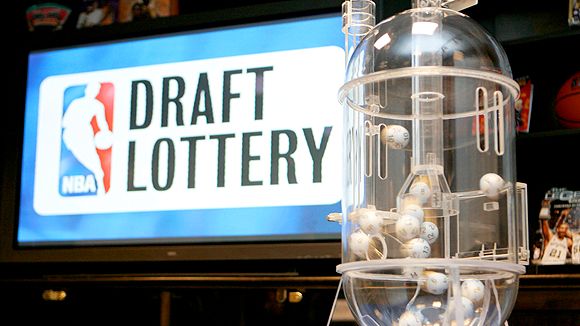
You should also check out my writeup dispelling some common misconceptions about the NBA Draft Lottery.

1

Nerlens Noel

C 7-foot 206 lbs Kentucky 19 Years Old

The Cavaliers luck out again, winning their third lottery in eleven years. They have cornerstone starters at point guard, shooting guard, and power forward, so that leaves them essentially looking at Nerlens Noel and Otto Porter Jr. for the first overall pick. Porter will help more right now, but he doesn’t have nearly the ceiling of Noel, who could be a better version of Anderson Varejao.

2

Ben McLemore

SG 6-foot-5 189 lbs Kansas 20 Years Old

Had the Magic landed the number one pick, there’s no chance Noel could have lived up to the other three number one picks Orlando has had: Shaquille O’Neal, Chris Webber, and Dwight Howard. The Magic is a bit of a mess and really just needs talent, so Ben McLemore makes the most sense since he’s the next best player on the board.

3

Otto Porter Jr.

SF 6-foot-9 198 lbs Georgetown 19 Years Old

Porter is probably my third favorite player in the draft after Noel and Bennett, and he’s a perfect fit for Washington. They already have franchise building blocks in John Wall and Bradley Beal, so they just need a forward who make an impact even without the ball. Bennett also makes some sense here, too.

4

Anthony Bennett

PF 6-foot-8 240 lbs UNLV 20 Years Old

The Horncats need help at about any position other than point guard and small forward. The Bobcats biggest issue last year–besides a lack of talent–was a lack of a quality big man. Anthony Bennett is only 6-foot-8, but he has a 7-foot-1 wingspan, and he dominated on the glass last year. Like fellow Charlotte draft pick and former Running Rebel Larry Johnson, Bennett overcomes his lack of height with a strong perimeter game.

5

Victor Oladipo

SG 6-foot-4 213 lbs Indiana 21 Years Old

No team is in a bigger mess than the Suns. They have no young player you can point to and say that they will be a starter in the future. Kendall Marshall, the Morris twins, and Wesley Johnson may all become nice role players, but nobody will win a NBA championship with Michael Beasley starting. With Marshall and Goran Dragic on roster, Trey Burke doesn’t make a ton of sense here, but Victor Oladipo is the hard-working type of player the Suns need to build around.

6

Trey Burke

PG 6-foot-1 217 lbs Michigan 20 Years Old

New Orleans would be lucky if Trey Burke fell this far. They desperately need an upgrade at point guard since Austin Rivers looks like he may go the way of Jonny Flynn, and Burke could supply some extra star power to the team. Burke, Eric Gordon, and Anthony Davis would be a very nice core.

7

Tyler Zeller

PF 7-foot 230 lbs Indiana 20 Years Old

Zeller started the year as the favorite to be the number one pick, and at one point nearly fell out of the lottery. But after putting up ridiculous numbers at the NBA Draft Combine, I think his stock will rocket back up in the coming weeks. He’s definitely better than Alex Len. But the Kings need a forward who can make an impact without needy the ball–since the draftee wouldn’t get the ball playing with Tyreke Evans, Jimmer Freddette, Marcus Cousins, John Salmons, Isaiah Thomas, and DeMarcus Cousins.
8

Shabazz Muhammad

SF 6-foot-6 222 lbs UCLA 20 Years Old

I’m still a big Shabazz Muhammad fan despite a so-so freshman year, a poor combine, and the revelation that he is a year older. The Pistons need a wing player to compliment Brandon Knight, Greg Monroe, and Andre Drummond, and Muhammad would fit  the bill. This could be the fourth consecutive lottery that a potential All-Star falls to the Motor City.

9

C.J. McCollum

SG 6-foot-3 197 lbs Lehigh 21 Years Old

I’m not a huge fan of McCollum since he’s undersized and didn’t face much competition at Lehigh, but the similar thing (schedule-wise) was said of Damian Lillard last year. The Wolves are lacking on the wing, and they’ve been searching for a shooting guard since Randy Foye left (that’s a low bar). The Timberwolves like the guy, so maybe they’re onto something. I don’t know.

10

Kentavious Caldwell-Pope

SG 6-foot-6 204 lbs Georgia 20 Years Old

I’m not really sure what took so long for teams to like this guy. He put up big scoring numbers at UGA (partially because he was the only redeemable player on the roster) and even rebounds well. And he has legitimate shooting guard size. The Blazers will likely look at Caldwell-Pope or go big with Alex Len–who probably shouldn’t still be on the board at ten.

11

Alex Len

C 7-foot-1 225 lbs Maryland 19 Years Old

The Sixers need size, and they’ve got plenty of options in this scenario. Alex Len has had his ups and his downs, but he has a chance to be one of the best players in the draft. He’s the tallest non-Rudy Gorbert player in the draft, and he has a nice offensive skill set that wasn’t shown off at college because he didn’t get the ball enough at Maryland. Between the options available at this point and his health, I don’t see the Sixers bringing back Andrew Bynum.

12

Steven Adams

C 7-foot 255 lbs Pittsburgh 19 Years Old

With the departure of Andrew Bogut, the Bucks are seriously hurting for size. Terrence is another weird character–he’s the size of a small forward, but he’s not quick enough to guard the position. He’s got a world of talent, but often will disappear for halves at a time. I see him as a stretch four in the pros–like he played at Kentucky–but he could go much lower than this in the draft.

13

Dario Saric

SF 6-foot-10 223 lbs Croatia 19 Years Old

This pick likely comes down to Dario Saric and Michael Carter-Williams for the Mavs. Both are home run picks and fill different needs. Darren Collison is good, not great at the point guard, and the Mavericks have no long-term players at small forward. Dallas apparently thinks Saric can be a star, and he has that upside, and he could prove to be a worth heir apparent for Dirk Nowitzki.

14

Michael Carter-Williams

PG 6-foot-6 184 lbs Syracuse 21 Years Old

Enes Kanter and Derrick Favors look like franchise building blocks, and the Jazz really like Gordon Hayward and Alec Burks, so that leaves them with a nice big hole at point guard. Enter, Michael Carter-Williams. He’s got incredible size and great athleticism; his only problem is that he has a broken jump shot. If he’s off the board here, Shane Larkin could make a lot of sense, even as a massive reach.

Categories: NBA | Leave a comment

A Brief Lottery Briefing

You won’t find me in any college math classes after my adventure with multivarible calculus, but I fancy myself a mathematical person. And being a big fan of the NBA Draft, you can bet I’m a fan of the NBA Draft Lottery.

Sure, I wasn’t happy when my Bobcats lost the #1 pick to the Hornets–boy this is going to be confusing looking back in a few years–after they had nearly three fewer wins than the second worst team in the league. But the Lottery disincentives tanking and adds excitement to the league, so it is a good thing.

There are a few things that bother me about the lottery. It’s not necessarily about how the process is done, but rather how people look at the lottery.

Specifically, the magical word “due.”

I’m not sure if people forgot what they learned in high school math (very possible) or if they believe in karma over logic, but this isn’t how odds work.

The lottery is a simple (?) process.

aaa

Obviously the Magic will win the lottery because they lost Dwight. Or it’s going to be the Pelicans or future Hornets because they’re changing nicknames. Or the Kings because they won’t be relocated.

There are 14 ping pong balls each numbered one through fourteen. Four ping pong balls are randomly drawn (the order does not matter), which gives us 24,024 combinations. Simplify that by a factor of 24 and you get 1,001 combinations, then drop the last combination and you have an even 1,000 combinations. Each team is assigned a certain number of combinations, determined by their record, and you have each team’s odds at landing a lottery pick.

Four ping pong balls are continuously drawn until three unique teams are selected. The rest of the picks are organized by record.

It’s all luck. There’s no “due.” And there’s no conspiracy. You can make up a conspiracy theory for any team.

This idea of a team being “due” continues even today–an article ran about it in the Dallas Morning News–despite it making no sense.

Yes, the Bobcats, Suns, and Pistons have never won the lottery, but that doesn’t mean they’re more likely to win it now. The fourth pick has never won the lottery, but that doesn’t mean Phoenix has a better or worse shot. The Magic have won it three times, but that doesn’t mean anything either.

Each draft is completely separate. It’s just odds each time.

Imagine using Chad Ford’s Mock Lottery Machine nineteen times, never coming up with the Phoenix Suns first. What is the chance you get the Suns with the first pick on your twentieth try? Is it 80% since they haven’t come up yet so they have to soon? Is it 2% since they haven’t been chosen yet, so they probably still won’t?

Nope, it’s still 11.2%, like always.

Since the lottery was weighted in 1994 so that the team with the worst record has a 25% chance of landing the top pick, the team with the best odds has only won twice. Two out of nineteen is not very good–10.5% is less half the odds of 25%. Yeah, I can do math.

So is the NBA rigging it so that the team with the worst record doesn’t get the number one pick? We can check if that 10.5% actually statistically significant–suggesting the lottery is rigged–or if it is just due to random variation by using a binomial distribution. Who’s excited for some math?!

And in fact, the binomial distribution gives us a p-value of .07, which is bigger than .05 and therefore too large for us to reject the null hypothesis. In layman’s terms, there is not enough evidence for us to say that the lottery is rigged.

Well maybe they’re not just preventing the worst team from winning the lottery, they’re just selecting the first winner because of a narrative. We can check this by running a chi-square test on the lottery winners.

Again, the chi-square test gives us a p-value of .089, which is still to large for us to reject the null hypothesis. We don’t have enough evidence for us to say the first overall pick is rigged.

But maybe it’s not the first pick that’s rigged, but rather all three winners of the lottery. We can check that again by running a chi-square test.

No surprise here, the p-value is very high: .355. Using that data, it’s almost comical to suggest that the lottery is rigged.

I know the last thing anyone wants before they excitedly watch grown men drawn ping pong balls is a math lesson, but this should help dispel any misguided thoughts about tonight’s lottery.

Categories: NBA | Leave a comment

Boston Strong

School is over at Vanderbilt, but I’m still writing for InsideVandy.com–for a good reason. I stumbled across a great story following the tragic the bombings at the Boston Marathon, and it turned out to be probably my favorite article I’ve written this year.

My article, Boston Strong, is a 1500-word longer-form piece about how the tragedy affected the Vanderbilt baseball team. The Commodores have a particularly strong New England presence with six student-athletes from Massachusetts and Coach Corbin from New Hampshire.

I also decided to make a podcast to share the full interviews with Tyler Beede, Corbin, and Rhett Wiseman along with Beede’s song Boston Strong. Check out the podcast–linked below–and feel free to share it with a friend, or two, or twenty.

The Knuckle Cast Episode #4

_

_

_

_

_

_

_

_

_

_

Your prize for making it through the podcast

Categories: College Baseball, Podcasts | Leave a comment

A Preconceived Idea of What It All Meant

Something very big happened in the sports world–something larger than wins and losses.

We like to think of ourselves as living in a progressive society with acceptance for all people, yet we’re reminded how backwards things still are when Mississippi finally ratified the Thirteenth Amendment less than ten weeks ago.

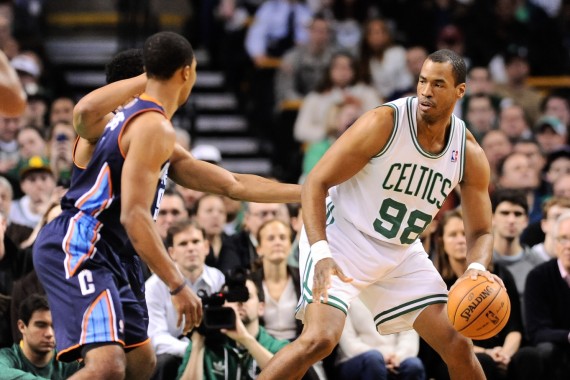
But this morning, Jason Collins did something no active athlete had ever done before. To quote his Sports Illustrated first-person story:

“I’m a 34-year-old NBA center. I’m black. And I’m gay.”

Collins became the first active athlete in the four major American sports to come out, something for which he should be commended. It takes a lot of courage, especially in our culture that is still insensitive to many minorities. Especially in a league like the NBA, where there is a sadly prevalent use of hurtful slurs, even by star players who are supposed to be roles models. Especially when artists like Lil Wayne will drop that same word without a second’s thought in his verse in Look At Me Now.

a

Side note: how did nobody ask Collins why he wore the number 98? The great Hamed Haddadi is the only other player in NBA history to don that unique number.

But who Jason Collins is doesn’t change the player he is. Even if he never plays another minute in the Association–he’s a free agent this summer coming off his sixth team in twelve years–today’s news doesn’t change the fact that he’s a very strong interior defender, a near-champion in the NCAA and NBA, and a beloved teammate. My opinion of him as a player–like all teams’, players’, and fans’ should–remains the same as it was less than twenty-four hours ago.

Jason Collins’ true legacy will be the day when an athlete coming out will not be news. Because it won’t matter. Hopefully Collins’ big decision will even inspire other players to open up about themselves. Jason Collins should return to the NBA because he is still a serviceable rebounder, defender, and mentor–or at least better than 40-year old Juwan Howard–not because it would make a good story.

But there’s a solid chance that Jason Collins won’t be back in the league next season. Not because he’s black. And not because he’s gay. Because that doesn’t matter in player evaluation. And if anyone thinks it should, Collins was, by all accounts, a fantastic teammate, and he’s the same person today that he has been for the past twelve years. The man never caused any problems in the lockerroom before, so if an issue arises, that becomes the teammate’s problem.

Jason Collins may never play another minute in the NBA–but that’s because he’s a 34-year old center with no post game. When running an team, that’s all that matters. Strip away the fear, underneath Collins is the same as any other 7-footer. And that’s the way things should be.

Categories: NBA | 1 Comment

A Memory Stuck Like A Tattoo

The first time I interviewed Vanderbilt shooting guard A.J. Astroth, I asked him a rather open-ended question: “What’s something most people don’t know about you?”

A.J. took a while to respond, then turned to sophomore forward Shelby Moats, who was walking out of the gym.

AJTat“What’s something most people don’t know about me?”

It took Shelby a few seconds, too, until he finally said, “you’re tatted.”

Well that was kind of obvious. A.J. is has more ink than a finals paper.

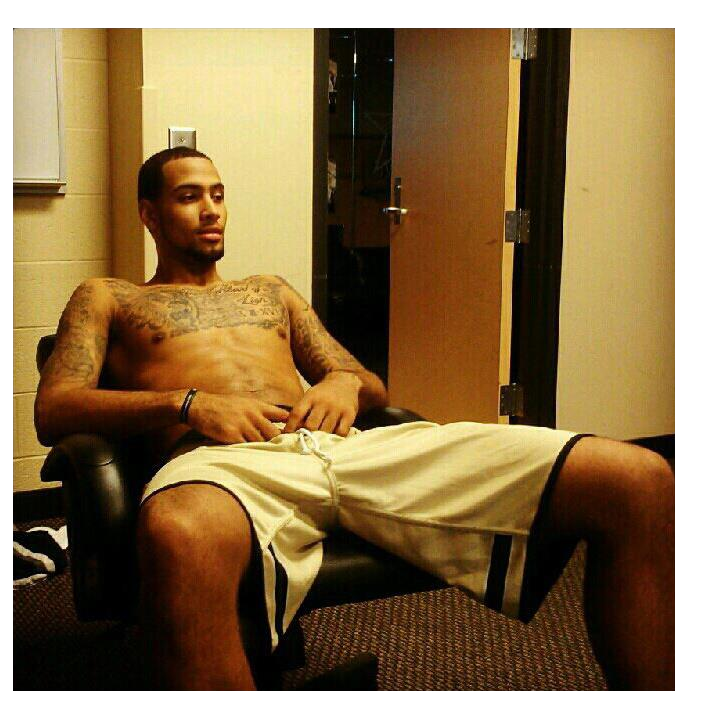
He’s got a giant lion on the right side of his chest with the words “Heart of a Lion” – the 6-foot-6 freshman is a Leo, after all.

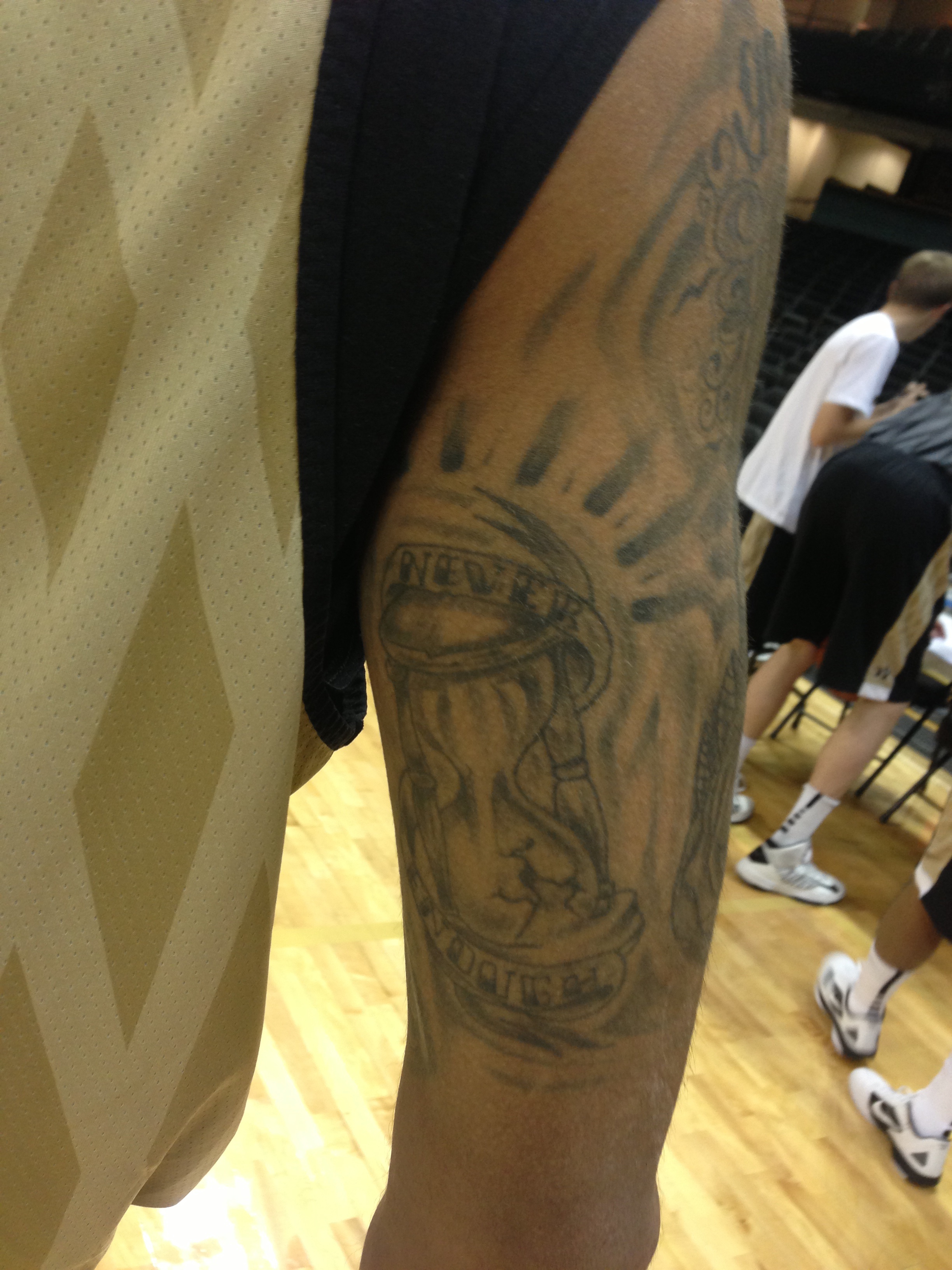
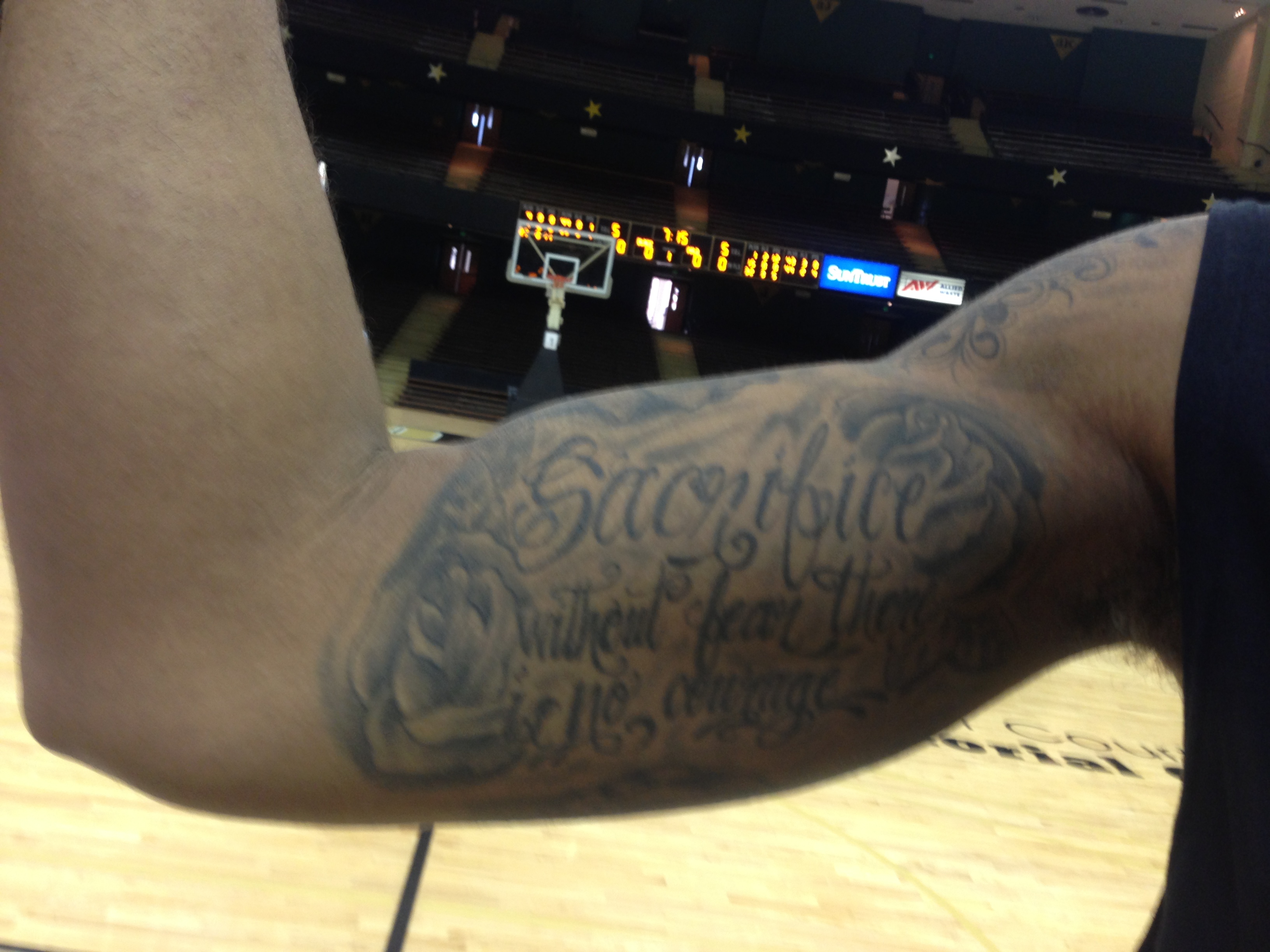
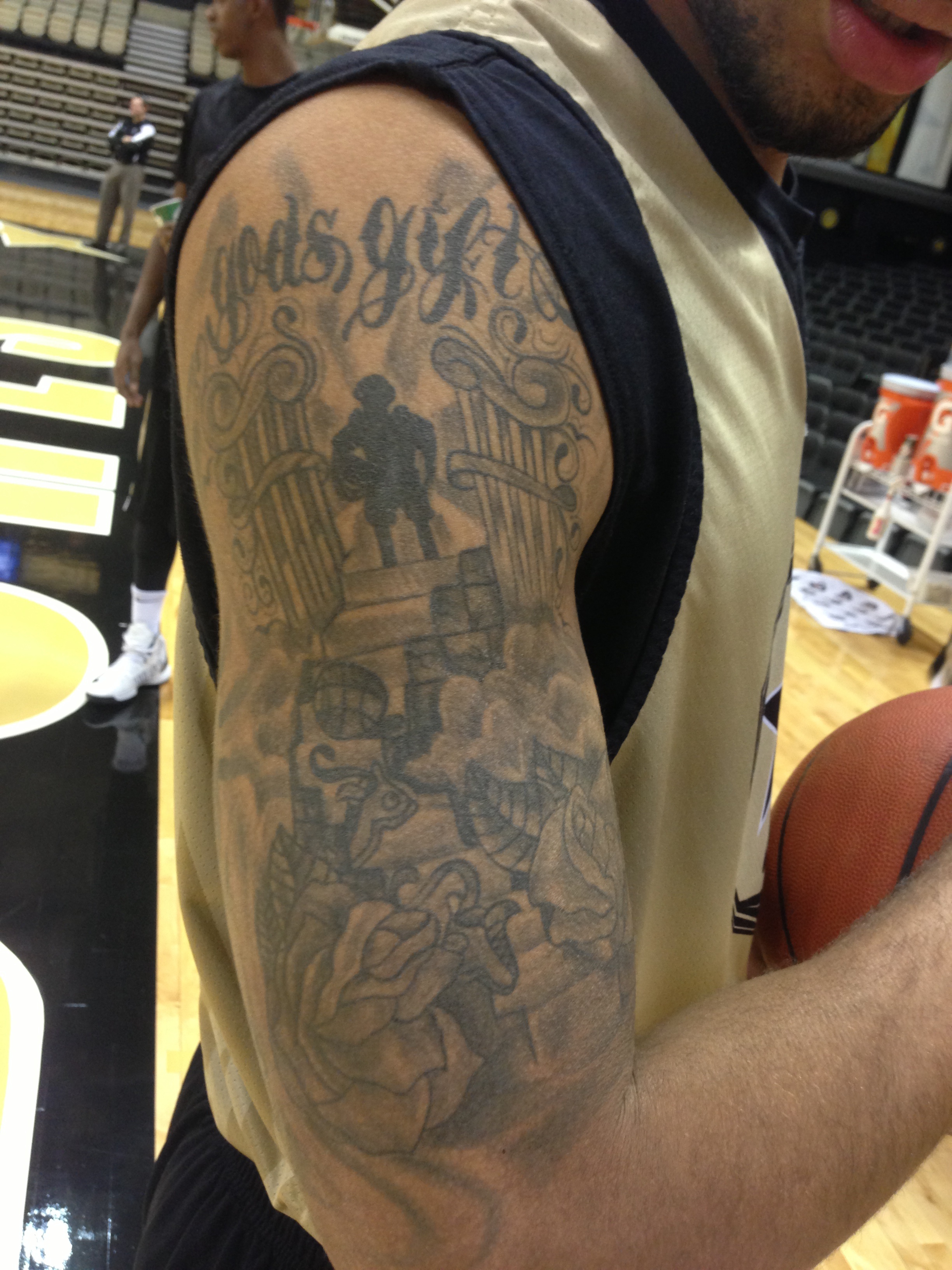
On his right arm, Astroth has an image of a staircase heading up to a gate with the shadow of a basketball figure and the words “God’s Gift.” His tricep has a cracked hourglass with the words “Never Enough” wrapped around it. On the inside of his arm? The phrase “Sacrifice: without fear there is no courage.”

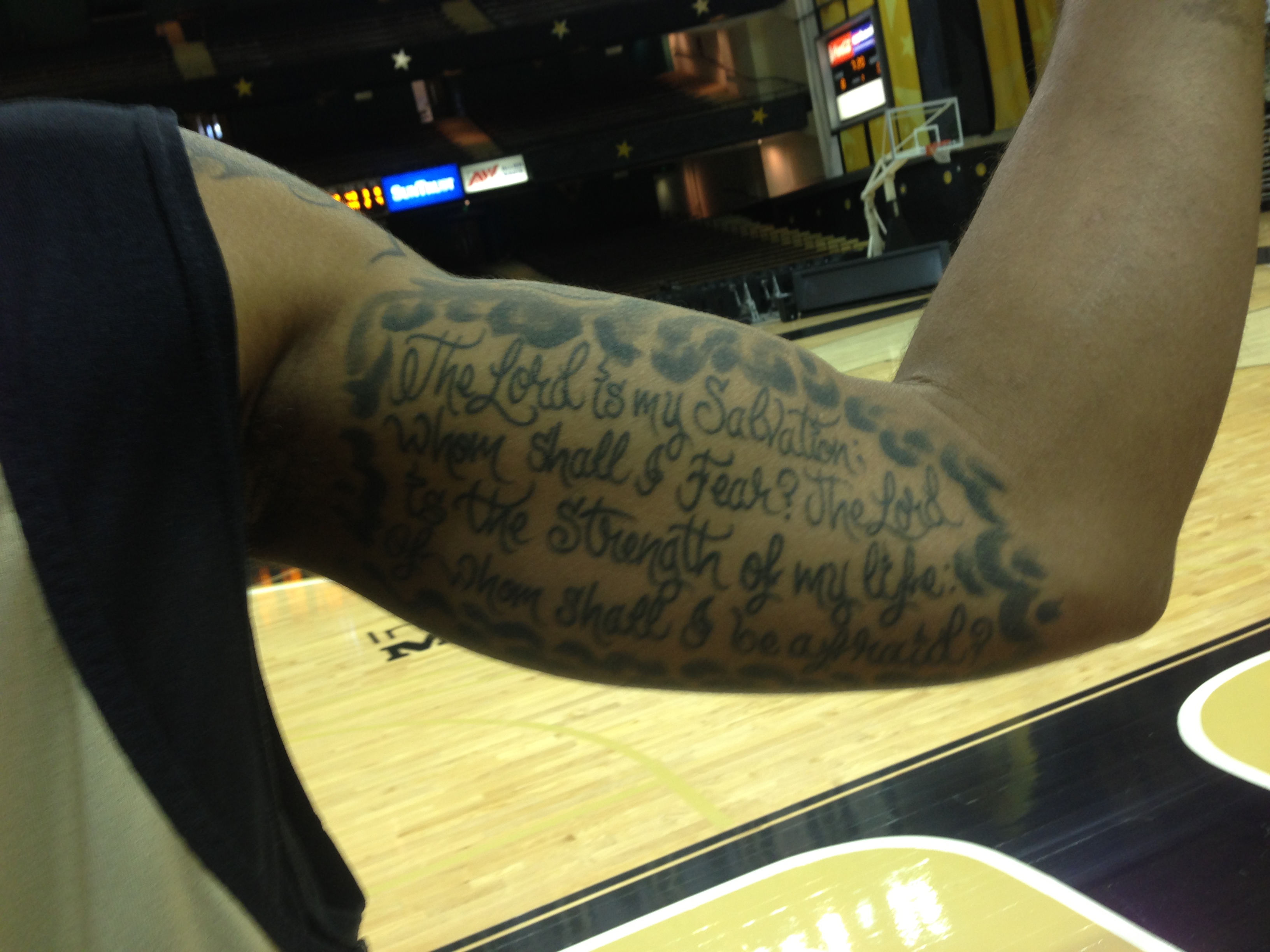
And then there is his right arm. On his right arm, there is an intricate cross with the words “Psalm 27” along with the dates 1926 and 2008. There is a rosary on the back of his arm and the beginning of Psalm 27 printed on the inside of his arm

The Lord is my salvation: Whom shall I fear? The Lord is the strength of my life: Of whom shall I be afraid?

This arm is dedicated to A.J. Astroth’s grandmother.

LArmInsideLeftAstroth was born in Germany because his father worked in the military. Since his mother also had to work a lot, A.J.’s grandma helped raise him until the age of seven.

According to Astroth, his grandmother had at least 15 children and did not have any education past the eight grade, but he considers her one of the smartest women he’s ever met.

“She always knew exactly what to say for every situation,” said Astroth. “Just looking up to her, it was just something I grew up with. Knowing that everything’s going to be all right, even when things didn’t seem all right because she always knew how to go about things.”

Beyond being such a wise woman, Astroth’s grandmother was also extremely religious. Astroth can still remember the long, lively church services he would go to with her, but the more important religious aspect of his grandmother were the lessons and moments at home.

BackRightRArm“She was always lecturing me or yelling at me or putting me on the right track,” Astroth recalled fondly.

But perhaps more important than keeping young Astroth in line with his behavior was her use of strong faith as a form of comfort.

“When I was a little kid,” said Astroth, “she used to read me Psalm 27 whenever I got scared. As I got older, when I wasn’t really scared of the dark or things like that but I would feel down on myself, she would read that to me. It would be like a motivator to me.”

To Astroth, this quote symbolizes rising above temptation, rising above the evils of the world. Above all else, walking with God and walking with faith.

Once both Astroth’s family moved back stateside, the two were separated. His grandmother moved to Chesapeake, Virginia, and Astroth now lives in Tampa, Florida. Despite the distance between cities, Astroth still managed to see his grandma once or twice a year.

When they did meet up again, times were good. Astroth can remember his grandma coming out to play basketball with him and his cousins, even as she was in her 70s. And then there was her famous cooking he always enjoyed.

InsideRightWhen his grandmother did pass away, the whole family went through a tough time. Astroth knew he wanted to get a tattoo to commemorate her, but he wanted to wait until he was older.

During his junior year, Astroth’s mother finally allowed him to go get his first tattoo, the one he had been planning since his grandmother’s passing.

“I felt like I just wanted to get something to remind myself to always keep going no matter what.”

From a short glance at A.J. Astroth’s tattoos, it’s not hard to see that he derives lots of his motivation from religion. Between the rosary, cross, psalm, and “God’s Gift” moniker, that much is clear.

But what most people may not know about A.J. is the lifelong impact one great woman can have on a basketball player’s life.

Categories: College Basketball | Leave a comment

2013 Baseball Preview

Well, folks, it’s finally here. After months of hard work, research, writing, formatting, editing, blood, sweat, and not that many tears (I swear) the 2013 Baseball Preview has arrived.

First the bad news: this year’s issue is not 105 pages. In fact it shrunk for the first time in my seven years of writing this to 38 pages.

But there’s good news: You get another year of my baseball preview with better content than ever. And it’s 100% free. Unless you really want to pay, then just email me bwweinrib@gmail.com and something can be arranged.

Enjoy!

2013BaseballPreview.pdf (page 1 of 38)

Categories: MLB | 2 Comments

2013 Top 50 MLB Prospects

It’s been a while, folks. A month and a day, actually. Between school work, finishing up my baseball preview, and pledging a fraternity, I haven’t had a ton of time on my hands, but I’m happy to issue my first sneak peak at my 2013 Baseball Preview.

Just like the past two years, I’m offering a look at my scouting reports on baseball’s top 50 prospects a little in advance of the publishing date (within 10 days, be ready). In the actual preview itself, each team will again have scouting reports for their top 10 prospects along with individual grades.

Unfortunately, this year’s preview won’t be quite as big as last year’s. Ain’t nobody got time for 108 pages. Instead, we’re looking more at something between 32 and 40 pages. For now, enjoy an early look at baseball’s future stars.

Notes:

  • Two players (Oscar Taveras and Xander Bogaerts) jumped from the 40s to the top 5.
  • Only 26 players return from last year’s top 50 prospects list.
  • 14 players graduated to the majors.
  • 10 players fell off the top 50 list from last year.
  • Of the 24 new players to the list, 10 were selected in the 2012 draft.
  • 13 of the top prospects were taken in the first round of the 2011 draft, the most among any draft.
  • Billy Hamilton (2nd round), Jonathan Singleton (8th), Mason Williams (4th), and Austin Hedges (2nd) were the only players drafted outside the first round, excluding the 12 players signed in international free agency.

Positional Breakdown

  • 4 Catchers
  • 1 First Baseman
  • 1 Second Baseman
  • 3 Third Basemen
  • 7 Shortstops
  • 11 Center Fielders
  • 5 Right Fielders
  • 17 Right-Handed Pitchers
  • 1 Left-Handed Pitchers

1. Jurickson Profar

SS Rangers mlb_profar_jurickson_65
H/W: 5’11” 165 2012 Ranking: 9 Age: 19 B/T: B/R
Profar shows all the tools (home run power may come soon) with an outstanding approach. With such a complete game, he’s the top prospect in baseball.

2. Wil Myers

RF Rays mlb_myers_wil_65
H/W: 6’3″ 190 2012 Ranking: 13 Age: 22 B/T: R/R
He has a great bat with plus plus power. There’s really nothing to dislike unless you want to be picky about his strikeouts. Myers will be on the Evan Longoria-esque delayed call-up this year.

3. Oscar Taveras

RF Cardinals mlb_tavares_oscar_65
H/W: 6’2″ 180 2012 Ranking: 41 Age: 20 B/T: L/L
His swing may look a little funky, and he tends to be overly aggressive at the plate, but Taveras can absolutely rake. Hit hit, power, and fielding tools are all well above plus.

4. Dylan Bundy

RHP Orioles mlb_bundy_dylan_65
H/W: 6’1″ 195 2012 Ranking: 8 Age: 20 B/T: B/R
Bundy has exceptional polish, especially a twenty-year old. The man has four plus pitches how that he’s re-added his cutter to his repertoire; MLB’s best pitching prospect.

5. Xander Bogaerts

SS Red Sox mlb_bogaerts_xander_65
H/W: 6’3″ 175 2012 Ranking: 44 Age: 20 B/T: R/R
He can absolutely rakes with 30+ home run power when he’s fully developed. Bogaerts reached AA at 19 and has far less questions about if he can handle shortstop, at least for the time being.

6. Gerrit Cole

RHP Pirates mlb_cole_gerrit_65
H/W: 6’4″ 215 2012 Ranking: 5 Age: 22 B/T: R/R
Cole’s fastball is a doozy and reaches as high as 102, although it can be flat and lacking command. That, with his exceptional changeup and slider make him a true ace.

7. Jose Fernandez

RHP Marlins mlb_fernandez_jose_65
H/W: 6’2″ 220 2012 Ranking: NR Age: 20 B/T: R/R
Having four plus pitches (fastball, curveball, changeup, and slider), along with great peripheral numbers makes Fernandez’s future tantalizing. At just 20, he has an extremely high ceiling.

8. Jameson Taillon

RHP Pirates mlb_taillon_jameson_65
H/W: 6’6″ 225 2012 Ranking: 11 Age: 21 B/T: R/R
Taillon has tremendous stuff with inconsistencies you’d expect from a 21-year old. Very reminiscent of Gerrit Cole in his final year at UCLA; another ace.

9. Byron Buxton

CF Twins mlb_buxton_byron_65
H/W: 6’1″ 188 2012 Ranking: IE Age: 19 B/T: R/R
Arguably the top talent in the 2012 draft, Buxton is crazy athletic with elite speed, a huge arm, big bat and future power. Give him time, Buxton is the complete package.

10. Carlos Correa

SS Astros mlb_correa_carlos_65
H/W: 6’4″ 190 2012 Ranking: IE Age: 18 B/T: R/R
The actual top pick in 2012 draft, Correa is a strong defender despite his 6’4” frame. He may have to switch to third if he beefs up too much, but he’ll hit for average and big power.

11. Zack Wheeler

RHP Mets mlb_wheeler_zack_65
H/W: 6’3″ 180 2012 Ranking: 27 Age: 22 B/T: R/R
Wheeler has great velocity and a plus curveball to go with a solid slider and changeup. Top-of-the-rotation future, but the Mets have not pushed him very quickly so far.

12. Christian Yelich

CF Marlins mlb_yelich_christian_65
H/W: 6’4″ 189 2012 Ranking: 34 Age: 21 B/T: L/R
All five of his tools are above-average, and he should be able stick in center field, despite switching from first base. He’s going to hit for a very good average; if power develops, he’ll be a star.

13. Miguel Sano

3B Twins mlb_sano_miguel_65
H/W: 6’2″ 245 2012 Ranking: 19 Age: 19 B/T: R/R
He’s patient, has a cannon arm, and has the most raw power in the entire minors. Sano strikes out too much (contact has been an issue), and his frame and footwork may move him to first.

14. Trevor Bauer

RHP Indians mlb_bauer_trevor_65
H/W: 6’1″ 185 2012 Ranking: 10 Age: 22 B/T: R/R
Bauer is very smart with polarizing attitude that helped him fall out of favor in Arizona. Regardless, he has number one starter stuff, and his command needs polish. He’ll be just fine.

15. Mike Zunino

C Mariners mlb_zunino_mike_65
H/W: 6’2″ 220 2012 Ranking: IE Age: 21 B/T: R/R
Zunino is great all-around with plus bat, intriguing power, and strong defense. As far as catchers go, he’s the complete package and nearly ready to help out at the major league level.

16. Travis d’Arnaud

C Mets mlb_darnaud_travis_65
H/W: 6’2″ 195 2012 Ranking: 16 Age: 23 B/T: R/R
A solid defender with a strong arm. The man has plus raw power and a nice bat–the only thing to worry about are injuries. He’s had more than 280 plate appearances in two of his five seasons.

17. Taijuan Walker

RHP Mariners mlb_walker_taijuan_65
H/W: 6’4″ 195 2012 Ranking: 21 Age: 20 B/T: R/R
Walker has an athletic frame and his numbers are deceptively bad since he reached AA at the age of 20. He has a very high ceiling thanks to a plus fastball and secondary offerings.

18. Shelby Miller

RHP Cardinals mlb_miller_shelby_65
H/W: 6’3″ 195 2012 Ranking: 6 Age: 22 B/T: R/R
Had a bit of an off-year, but his fastball still reaches the upper 90s to go with a plus curveball. He can be homer prone, but Miller is ready to pitch in the majors as a starter now.

19. Julio Teheran

RHP Braves mlb_teheran_julio_65
H/W: 6’2″ 175 2012 Ranking: 4 Age: 22 B/T: R/R
Another guy who had a bad year but reached the majors at a young age. Teheran features a plus fastball, and changeup, although his command and curveball could improve.

20. Tyler Skaggs

LHP D-Backs mlb_skaggs_tyler_65
H/W: 6’4″ 195 2012 Ranking: 18 Age: 21 B/T: L/L
Skaggs has an above-average fastball, a plus curveball, and a potentially plus changeup. His floor is relatively high since he’s already been able to knock out lefties and righties.

21. Addison Russell

SS Athletics mlb_russell_addison_65
H/W: 6’0″ 185 2012 Ranking: IE Age: 19 B/T: R/R
A hidden gem of the 2012 draft, Russell is a potential five-tool player with real star power. He has shown shaky footwork before, but he’s athletic enough to stick at shortstop.

22. George Springer

CF Astros mlb_springer_george_65
H/W: 6’4″ 2405 2012 Ranking: 40 Age: 23 B/T: R/R
People knock him because of his age and strikeout issues, but that Astros have been slow to promote him is not his fault. He’s an absolute five-tool prospect, although he may only hit .270.

23. Archie Bradley

RHP D-Backs mlb_bradley_archie_65
H/W: 6’4″ 225 2012 Ranking: 15 Age: 20 B/T: R/R
Bradley has a nasty fastball-curveball combo and great size and athleticism. There’s no doubting his ace upside despite, but he’s got a ways to go and command issues to iron out.

24. Billy Hamilton

CF Reds mlb_hamilton_billy_65
H/W: 6’1″ 160 2012 Ranking: 49 Age: 22 B/T: R/R
Hamilton is absurdly speedy (155 steals last year) and great on-base skills thanks to plus bat speed. He’s been moved off shortstop to center field, where he can really show off his legs.

25. Francisco Lindor

SS Indians mlb_lindor_francisco_65
H/W: 5’11” 175 2012 Ranking: 50 Age: 19 B/T: R/R
Lindor is quietly an outstanding defender with plus speed and on-base skills. He is very mature for his age (19), but one hopes he will develop more power by the time he hits the show.

26. Anthony Rendon

3B Nationals mlb_rendon_anthony_65
H/W: 5’11” 170 2012 Ranking: 23 Age: 22 B/T: R/R
Rendon has been hampered by ankle injuries (not good news if the Nats want him at second), but he  rakes when he’s healthy. He’s got great instincts and discipline but just solid power.

27. Javier Baez

SS Cubs mlb_baez_javier_65
H/W: 6’1″ 205 2012 Ranking: NR Age: 20 B/T: R/R
Baez has proved to be a surprisingly strong defender considering his muscly frame. He’s an aggressive hitter with plus bat speed good raw power, and playable speed on the bases.

28. Lucas Giolito

RHP Nationals mlb_giolito_lucas_65
H/W: 6’6″ 225 2012 Ranking: IE Age: 18 B/T: R/R
Giolito was nearly first-ever high school pitcher taken first overall before he hurt his elbow. Still, his raw stuff is fantastic with triple-digit heat and a plus plus curveball. Not worried about his future health.

29. Carlos Martinez

RHP Cardinals mlb_martinez_carlos_65
H/W: 6′ 165 2012 Ranking: 28 Age: 21 B/T: R/R
Despite his small frame, Martinez touches 100 mph regularly. His plus fastball actually draws a good amount of grounders, although his command just okay at the moment.

30. Jonathan Singleton

1B Astros mlb_singleton_jonathan_65
H/W: 6’2″ 215 2012 Ranking: 39 Age: 21 B/T: L/L
Singleton is suspended 50 games for marijuana use, but that doesn’t hurt his value. His hit tool is great, and power should come soon, although he needs more patience. His plus arm is wasted at first base.

31. Nick Castellanos

3B Tigers mlb_castellanos_nick_65
H/W: 6’4″ 210 2012 Ranking: 42 Age: 20 B/T: R/R
Castellanos hits very well for average and home run power should develop soon. He does need more patience at the plate. Detroit is playing him some in right field so Miguel Cabrera can boot more balls at third, which makes little sense to me.

32. Kevin Gausman

RHP Orioles mlb_gausman_kevin_65
H/W: 6’4″ 185 2012 Ranking: IE Age: 22 B/T: R/R
Gausman has high potential with a plus fastball and changeup. Assuming his breaking ball develops more, he’ll be another ace Baltimore can pair with Dylan Bundy.

33. Jackie Bradley Jr.

CF Red Sox mlb_bradley_jackie_65
H/W: 5’10” 180 2012 Ranking: NR Age: 22 B/T: L/R
An elite defender with remarkable instincts. Plays above his hit tool, which is good to start with, and above-average speed. He wields little power now, which would be the key to stardom.

34. Kyle Zimmer

RHP Royals mlb_zimmer_kyle_65
H/W: 6’3″ 215 2012 Ranking: IE Age: 21 B/T: R/R
One of the best 2012 college arms. Zimmer has a projectable frame, good command, and great stuff. His velocity uptick into the upper-90s really helped his draft stock, value.

35. Matt Barnes

RHP Red Sox mlb_barnes_matt_65
H/W: 6’2″ 205 2012 Ranking: NR Age: 22 B/T: R/R
His fastball works in the upper-90s with nice movement. Barnes wields a plus curve and control with a #2 starter ceiling. He hasn’t been tested at all above high-A, where he dominated.

36. Gregory Polanco

CF Pirates mlb_polanco_gregory_65
H/W: 6’4″ 170 2012 Ranking: NR Age: 21 B/T: L/L
A plus defender with plus speed and power. Polanco’s swing can get a bitlong, but he surprisingly doesn’t strikeout much. He’s always been toolsy, but didn’t start producing until now–boom or bust?

37. Aaron Sanchez

RHP Blue Jays mlb_sanchez_aaron_65
H/W: 6’4″ 190 2012 Ranking: NR Age: 20 B/T: R/R
Sanchez has three plus pitches including some upper-90s heat. His overpowering stuff covers up poor control, although he has plenty of time to correct that. Big-time upside.

38. Mason Williams

CF Yankees mlb_williams_mason_65
H/W: 6′ 150 2012 Ranking: NR Age: 21 B/T: L/R
Williams is an elite defender, with plus speed and an improving bat. He has a great approach on both sides of the ball, and may develop more power along the way.

39. Gary Sanchez

C Yankees mlb_sanchez_gary_65
H/W: 6’2″ 220 2012 Ranking: NR Age: 20 B/T: R/R
Sanchez is an aggressive power hitter with a plus bat. His bulky frame leads to long transitions, which he makes up for with a cannon of an arm. He should still stick behind the plate.

40. Taylor Guerrieri

RHP Rays mlb_guerrieri_taylor_65
H/W: 6’3″ 195 2012 Ranking: NR Age: 20 B/T: L/R
Guerrieri has been heavily limited by the Rays, but he’s a potential ace with plus fastball and curveball. The youngster has impeccable control but has only reached low-A.

41. Albert Almora

CF Cubs mlb_almora_albert_65
H/W: 6’1″ 170 2012 Ranking: IE Age: 18 B/T: R/R
Almora has above-average tools across the board; he just needs to refine his plate discipline and he’ll be on track. The man’s extremely polished for his young age (18).

42. David Dahl

CF Rockies mlb_dahl_david_65
H/W: 6’2″ 185 2012 Ranking: IE Age: 18 B/T: L/R
Another pleasant surprise out of the 2012 draft, Dahl is extremely athletic with five-tool potential. He’s not nearly as raw as once thought–a complete hitter with a chance to stick in CF as he fills out.

43. Alen Hanson

SS Pirates mlb_hanson_alen_65
H/W: 5’11” 152 2012 Ranking: NR Age: 20 B/T: B/R
Hanson shows great defense and speed tools, but hasn’t used them well yet (lots of errors and times caught stealing). He’s a legit switch-hitter who will hit for a high average and some power.

44. Bubba Starling

CF Royals mlb_starling_bubba_65
H/W: 6’4″ 180 2012 Ranking: 14 Age: 20 B/T: R/R
Starling is an elite athlete with high ceiling who hasn’t played up to his potential. He has plus power and bat speed, but his swing has some mechanical issues that lead to big strikeout totals.

45. Jorge Soler

RF Cubs mlb_soler_jorge_65
H/W: 6’3″ 205 2012 Ranking: IE Age: 20 B/T: R/R
This guy has enormous upside with massive power, a big arm, and impressive speed for his frame. The key for him will be adjusting to off-speeds and narrowing his pitch selection.

46. Austin Hedges

C Padres mlb_hedges_austin_65
H/W: 6’1″ 190 2012 Ranking: NR Age: 20 B/T: R/R
Hedges is an outstanding defender with surprising power. He could stand to take a few more pitches. He’s unlikely to fail, but also doesn’t ooze upside like the guy two spots below him.

47. Aaron Hicks

CF Twins mlb_hicks_aaron_65
H/W: 6’2″ 185 2012 Ranking: NR Age: 23 B/T: B/R
All five tools are finally setting in; Hicks is finally fulfilling his elite promise. At worst, he’s a plus defender with great speed and plate discipline. He always seems to start slowly.

48. Rymer Liriano

RF Padres mlb_liriano_rymer_65
H/W: 6′ 211 2012 Ranking: 32 Age: 21 B/T: R/R
The definition of boom or bust, although I’m a big fan. He’s got plus speed, raw power, and bat speed but poor pitch recognition. Defensively, he’s angy with cannon arm. You have to love the tools.

49. Delino DeShields Jr.

2B Astros mlb_deshields_delino_65
H/W: 5’9″ 188 2012 Ranking: NR Age: 20 B/T: R/R
DeShields Jr. is an elite athlete with insane speed, only overlooked because of Billy Hamilton’s ridiculousness. His bat is very much improved, and he can play either second base or center field.

50. Courtney Hawkins

RF White Sox mlb_hawkins_courtney_65
H/W: 6’3″ 220 2012 Ranking: IE Age: 19 B/T: R/R
I’m a big fan, and I don’t get why Hawkins doesn’t get more hype. He’s a tremendous athlete with plus power and arm strength to go with good speed. Improve plate discipline is the one big issue.

_

Categories: MLB | 2 Comments

What Do I Stand For?

There’s a saying that you should never meet your heroes because they might let you down. I’m not sure if I totally subscribe to that theory because I’ve gotten the chance to meet some of my favorite writers (Keith Law and Jonah Keri) and favorite athletes (Tyler Beede and DeAngelo Williams), and they’ve only raised my perception of them. Moreover, the saying should go: you should be cautious when you meet your heroes because they might let you down.

In the last thirty days, though, we’ve seen three major idols crumble and fall because of poor choices, lying, and lying about poor choices. In mid-January, Lance Armstrong finally admitted that he doped—but he claimed he didn’t cheat after 2005. He was emotional and remorseful, but he was also a lying cheater. We wanted to believe that Lance was clean—despite the fact that quite literally every other cyclist was dirty—because we wanted an American hero.

A man who overcame cancer and dominated a sport by winning seven straight Tour de Frances. Overwhelming evidence be damned, this man had to be telling the truth because, after all, he threatened to sue people who “slandered” his name. His reactions to accusations of doping were so visceral that he had to be telling the truth. But no, he turned out to be just like the rest of the cyclists. A cyclist who overcame cancer.

A few days later, another idol went crashing to the ground, this one in possibly the most bizarre way possible. Manti Te’o found his way into the hearts of Americans across the nation because of the heartbreaking story of his girlfriend—Lennay Kekua—who was in a terrible car accident, got leukemia, then died six hours after Te’o’s grandma died. Fueled by the terrible losses, Te’o went on to lead Notre Dame with 12 tackles en route to a 20-3 victory over Michigan State, nine more wins and an undefeated regular season, and nearly a Heisman trophy. Except there was one problem: Lennay Kekua never existed. She was a hoax.

The most inspirational story of the college football season was soiled because the Notre Dame linebacker fell in love with a girl over twitter and pretended to have met her and introduced her to his family. That is, unless he was in on the hoax the entire time, which would make him the most histrionic, attention-seeking, twisted player in recent memory. In one moment, Te’o went from sympathetic, inspiration figure to the laughingstock of the sports world, an unenviable mess.

I am the bullet in the chamber

Pistorius appeared in a Nike ad featuring the catch phrase “I am the bullet in the chamber.” The multi-billion dollar industry took all of twelve seconds to take one down.

Then comes the most recent letdown, the sad story of South African Olympian Oscar Pistorius. The man is the first double leg amputee to compete in the Olympics, earning him the nickname “Blade Runner.” His inspirational story touched millions of people—from South Africans to disabled people to sports fans in general—until he (accidentally) shot and killed his model girlfriend, Reeva Steenkamp. The jury remains out on whether or not he killed her on purpose—he claims he thought she was a burglar—but he is forever unclean in the eyes of many people. How can you look up to someone who killed someone they loved, even if they overcame seemingly insurmountable odds to reach the pinnacle of modern athletics?

In the end, it just seems that we cannot trust athletes and look up to them now. Maybe the saddest story of them all is the recent antics of LeBron James. The All-Star forward is trying to get into the good graces of sports fans’ hearts after leaving frigid Cleveland for beautiful Miami in order to better his chances to win a championship by playing the best basketball of his entire life. The shameless James is even working harder than ever to get teammates involved, rebounding at the highest rate of his career, and scored 30 points on 60% shooting or better in six straight games in a sad attempt to raise his image.

In the end, it’s really athletes like LeBron who will do anything for attention that make fans sick and leave us wondering if we should and can look up to any athlete.

Categories: College Football, NBA, Other | 1 Comment

Blog at WordPress.com.